The inner world is vaster than the outer, though the outer seems so large.
— — Ibn Sina, Kitab al-Isharat
The Palace and the Maze
Sarah’s scan reveals the heartbreaking truth: narcissism changes the brain. The answers lie in the ever-changing network of 100 trillion neuronal connections where we all live. 630
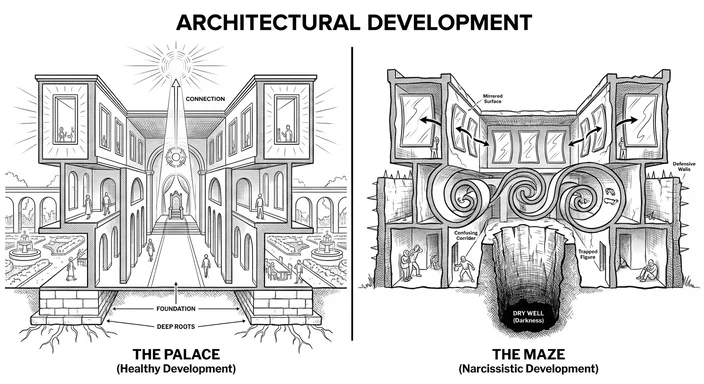
Imagine the mind, your intellect, as a vast palace, its chambers encoding experiences, its spires and towers reaching towards understanding, its foundations rooted deep in the brainstem. In healthy development, this palace is built with care—more precisely, with positive reinforcement. Each stone of experience is carefully placed. Each arch of connection is properly supported. Light streams through gloriously ornate coloured glass windows of perception, creating patterns of meaning that shift and dance but always maintain coherence.
Yet in the narcissistic brain: this construction project must build something defensive. A maze. No joy guides this construction, so some chambers meant to be palatial lie in rubble, and other parts recognise ever-present threat and so become hastily constructed defences. What are meant to be corridors and open spaces get walled off out of fear or confusion. What would be promising avenues of potential growth and exploration are shut down repeatedly and so lead nowhere. Everything becomes defensive, one interaction at a time. Fear builds evasive corridors and traps; frustration builds walls.
Finally comes the realisation that hits the child: they are not worth seeing, not worth knowing, not worth loving. This settles into their defining certainty. The infant brain knows their world, and anyone from that outer world is a threat. They must, at all costs, be prevented from reaching past these defences, and because an infant is not strong enough yet to fight, it must defend, or deflect.
Deflection leads to building an outer wall of mirrors where every surface facing experience reflects. The windows that would admit light from the outside world are silvered over. Every outer message gets reflected away; what does get through is distorted, its meaning rendered into a confusing, terrifying kaleidoscope that gets fed into anything which reduces the complexity into reactive responses.
The foundations, laid in trauma and neglect, shift and crack constantly under the onslaught of shifting experience—forcing the neurology to harden a structure built for defence against the world, rather than integrating with it. The throne room, where in healthy development we place our connection to something greater than ourselves, where our power is placed in service to the greater world, is empty and holds instead a single dry well, at the bottom of which is nothing. The child who built this place is gone.
Yet between the outer walls of mirrors and the well where a palace should be is something purpose built for deflection: a maze. An endless series of dead ends, where each corridor loops back on itself. The way forward is also the way back. The centre can never be reached because it was never properly formed. This is the paradox of narcissistic architecture: a self that is simultaneously grandiose and internally empty. The whole system is defensive yet vulnerable, brittle: always apparently seeking connection while deflecting intimacy.
Part I: Sensation to Self
The Foundation: Brainstem and Early Sensory Processing
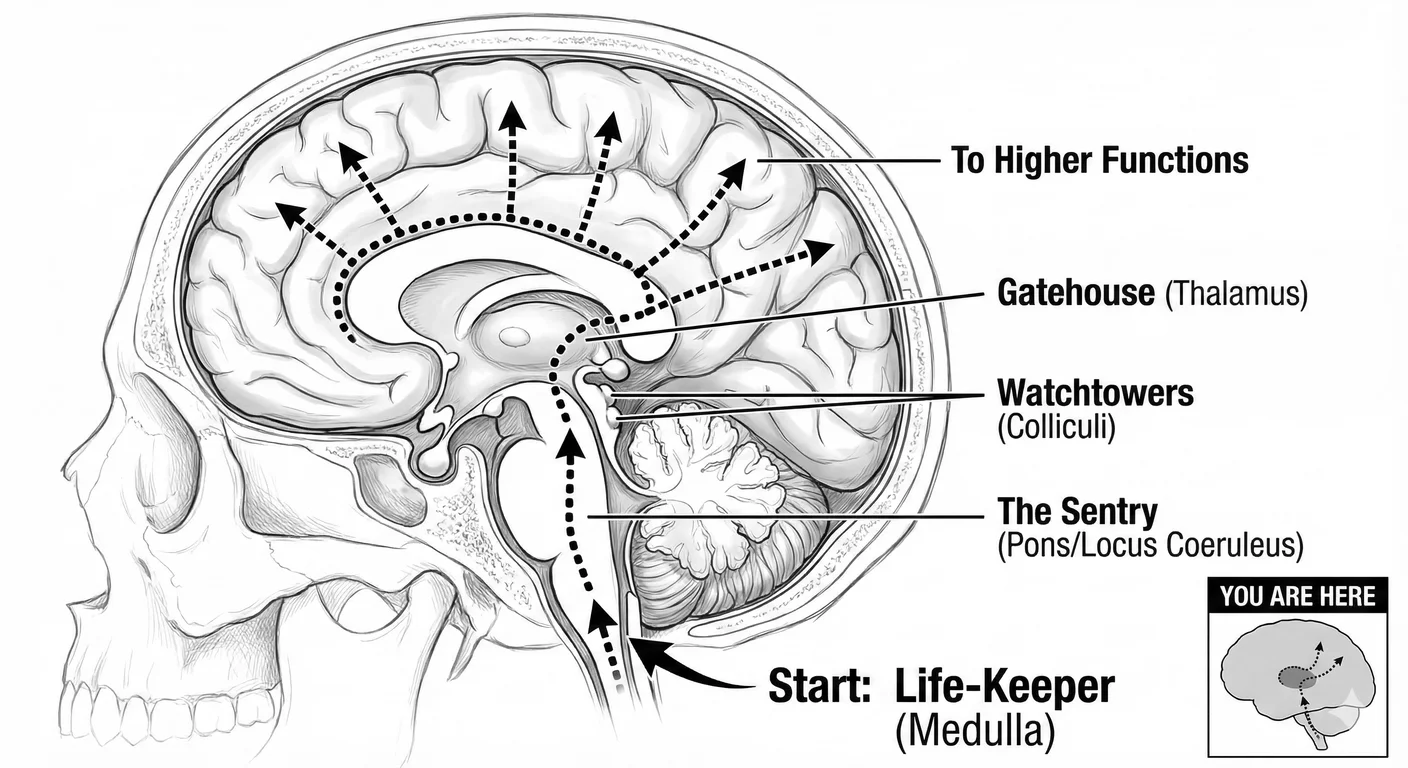
The ancient structures of the brainstem form the palace’s foundation. This is atop the spinal column, and where that main river of nervous signals enters the brain. In a healthy palace, these foundations are solid bedrock: they are stable in their processing, predictable, and so support everything built above them. In the narcissistic brain even these deepest stones are shifting because of early life trauma which led to a confusion between threat and comfort. As a result, all the structures which are built on narcissistic foundation become either rigid or turn to rubble.
The foundations house what we’ll call the Life-Keeper—the medulla oblongata—always controlling our breathing, regulating our heart rate, and also our vital reflexes. The body’s most critical survival activities. It receives the first whispers of bodily experience through the body’s sense of its own position in space (proprioception). Think of a baby feeling the pressure of being held, the temperature of skin against skin, and awareness of where the body ends and the world begins. These are threshold notifications: boundaries which define our interface with the world from the start.
In healthy development, we come to know these early sensory experiences as consistent and predictable. They give us security. The infant’s cry brings parental comfort. Loving touch brings soothing. The body’s signals are thus met with appropriate responses.
In the nascent narcissistic brain, these first translations of sensation into meaning are already being disrupted. The infant who cries and is sometimes comforted but on other occasions met with anger begins to encode uncertainty into the very foundations of their sensory processing. The brainstem is being trained that it can’t be sure when it cries for help whether it will get that help or receive hostility. These are the beginnings of attachment issues. And attachment theory tells us early caregiver interactions shape lifelong relating patterns.
Beside the Life Keeper is The Face-Reader (spinal trigeminal nucleus) which identifies and processes pain and touch from the face. In narcissistic brains, these become sensitive and reactive. The happy face or angry face are signals of whether they will receive comfort or more suffering. Research suggests people with narcissistic traits may show altered processing of facial pain signals as early as 100 milliseconds post-stimulus 1173 . This is well before conscious awareness can intervene. Their nervous system appears to have learned as a child to scan for threat in the very faces that should provide safety.
The Palace Sentry
As the river of sensory information rises through the brainstem, it encounters the brain’s Sentry, who determines whether the kingdom sleeps peacefully or goes on high alert. It should rouse the brain only for genuine threats. Due to uncertainty in the foundations, the whole world is treated as a threat, and so the Sentry never sleeps. Scientists call this Sentry the Locus Coeruleus (Latin: “blue spot”).
The Sentry is our brain’s principal source of the arousal hormone norepinephrine, which powers our fight-or-flight responses. What should be a controlled tap, opened only on specific occasions, becomes a fire hose left permanently on.
Recent research suggests that people with narcissistic traits may have enlarged baseline pupil diameter and reduced eye response to emotional stimuli. 1367 The brain appears locked in unrelenting arousal.
Further along, complementing the Sentry, is The Sandman (pontine reticular formation). He orchestrates our circadian rhythms, guiding sleep-wake transitions. Sleep research has recorded that those with NPD experience reduced REM density, thereby dreaming less, which interferes with consolidating emotional memories. 301 This means the maze within the narcissist’s mind is being constructed even during sleep. It struggles to properly process and integrate emotional experiences. The bricks do not fit.
The Midbrain Colliculi: Where Senses First Converge
Past the brainstem lies the midbrain, where four Watchtowers serve as the palace’s first multi-sensory lookout posts. They each sit on hills called “colliculi”. They usually scan the horizon of senses impartially, alerting the Palace to whatever approaches. In NPD the watchtowers are repurposed to instead scan obsessively for reflections of self while remaining blind to much else. They primarily scan visual and auditory streams.
Visual Watchtowers
Eye-tracking studies combined with brainstem imaging suggest that the Visual Watchtowers (superior colliculi) in NPD may show enhanced eye movements towards mirrors and reflective surfaces 823 . The narcissistic brain appears to be oriented at an unconscious level to seek its own reflection. This is more than vanity as we typically understand it: it may represent a fundamental shift in how the brain orients in space.
Sound Watchtowers
These normally help us locate sounds in space and process speech patterns. In the NPD brain, however, they show reduced activation to others’ vocal emotional content but enhanced activation to recordings of the individual’s own voice 933 . A narcissist would rather listen back to their own voice recordings than talk to someone right beside them.
Confused Spotlighting
These Watchtowers play a role in our startle response and also in threat detection. The narcissistic brain treats criticism as a survival threat while dismissing actual danger signals. 292 The watchtowers sound desperate alarms for imagined slights while remaining silent during genuine emergencies.
In the healthy brain, they create our first sense of unified perceptual experience. Disparate streams of previously unconnected sensory data are correlated into the seeds of real experiences and so into meaning. In NPD, this integration is biased from the start, painting a richer, more vivid perceptual experience of the self while others in their world remain barely noticed. 191
The Thalamic Hub: Sensory Relay and Filtering
Beyond the hills and their obsessive focus on searching for the self lies an egg-shaped wonder at the brain’s centre—the thalamus—the central relay station to the regions of the mind, the palace’s Gatehouse.
This Gatehouse is an anteroom to consciousness where sensory information is truly integrated and directed towards the cortical regions, the appropriate outer areas of the brain. Every sense (except smell) passes through this egg-shaped powerhouse, making it essential to how we perceive reality.
The gatehouse welcomes and then properly directs visitors to where they can find their place in the kingdom of the mind. What does this mean, where should it go, should it evoke a memory, should it be passed up to the control centre, and so on. It is a relay station as much as a Gatehouse, and several pathways lead out towards the various parts of the brain.
In the narcissistic maze, due to the threat neurology and the arousal, over time it distorts into a security checkpoint where every visitor faces scrutiny for either threat or tribute, and those deemed unfit find entry denied. Instead of an integrator and guide, helping things along, it acts as a censor, so consciousness does not have to deal with threats to ego. This has a dramatic impact on what the rest of the brain receives, and what it makes of that information. The censoring can cripple understanding progressively in its attempt to protect, and thereby ramp up frustration and confusion, forcing the NPD brain to ‘displace’ the work of making sense of the world to others.
Again, the Gatehouse also shows systematic bias in its censorship. For visual attention and relevance detection, it shows increased activation to self-relevant sights and sounds while showing decreased response to others’ emotional expressions 921 . It reinforces the pattern we saw at the Watchtowers. The censor also edits. It alters sensory information in how it ranks and processes data before reaching the conscious mind.
The Highway Builder (mediodorsal nucleus) is a thalamic relay to the palace Throne Room—the executive centre, known scientifically as the prefrontal cortex or PFC. The Throne Room integrates sensory experience into emotional states, thereby driving and determining our cognitive flexibility and working memory. It is where the ‘I’ lives. Brain scans show structural damage in the Highway connecting this relay station to the Throne Room in individuals with narcissistic traits—changes that correlate with deficits in cognitive empathy and emotional regulation. 873
Another highway, which we’ll call the Touch Translator (ventral posterior nucleus), passes tactile and temperature sensations from body to the Throne Room. It shows an interesting pattern in narcissists. They have heightened response to self-touch but diminished response to being touched by others 1089 . They literally do not receive the same level of comfort from physical touch and other normal human comforting behaviours. This neurobiological signature of self-focus extends even to the most basic levels of tactile processing. In daily life, a narcissist would prefer to play with their hair rather than hug someone else.
The Gatehouse complex illustrates how a healthy brain forms connections and meaning reliably. Narcissistic neural damage subverts this process, breeding isolation.
The Habit Machine: Basal Ganglia and the Automation of Narcissism
The brain’s machinery rooms—the basal ganglia—control movement and turn actions into habits. They manage the arc from intention through motion, through action, and all the way to the automation of habits leading to satisfaction.
This region of the brain turns our conscious decisions into automatic routines. It automates the mundane so the mind can focus on what matters. It clears space for us to think and feel, to reflect.
In the narcissistic maze, the machinery is still there; it still works. But it has been pared down to the bare essentials for survival. It now automates defence and the endless pursuit of supply. Habits of validation seeking build on each other, turning finally into systems of supply seeking. They automate the rigid, compulsive patterns that maintain narcissistic traits even when they recognisably cause suffering.
The currency for building these behaviours is dopamine, the brain’s reward chemical. The Habit Machine’s Reward Weigher (striatum) both processes reward and powers habit formation. The Weigher receives massive dopamine projections—neural pathways that carry signals between brain regions—encoding reward prediction and actively selecting and prioritising our habit formation.
In NPD, research suggests the Weigher responds intensely to anticipated social rewards (praise, recognition) but may barely register anticipated social punishments 513 . The brain appears to pursue validation relentlessly while failing to learn from social rejection. This may help explain why narcissists struggle to learn from interpersonal failures—and why their professional and personal relationships often collapse in cascading sequence.
The Habit Former (dorsal striatum) drives habit formation and shows accelerated habit learning for narcissistic behaviours. Actions that garner attention or admiration quickly become automatic, executed without conscious deliberation 487 .
The grandiose gesture and the self-referential story begin as deliberate strategies but become as automatic as walking. What we assume is conscious personality is literally habitual and robotic, encoded in basal ganglia circuits operating just below conscious awareness.
“Narcissistic loops”—repetitive patterns of seeking supply then crashing—originate here. Loops between the Weigher, the Gatehouse, and the Throne Room lock into place.
These circuits, which normally enable smooth behaviour selection, become stuck in NPD, creating behavioural perseveration 18 . The same story told repeatedly. The same relationship pattern enacted with different partners. These all represent basal ganglia loops that cannot be broken through conscious will alone.
Healthy people break their habits, change their ways, and learn from mistakes through a different mechanism.
The Brake
If the Reward Weigher is the Accelerator, then the Brake is our subthalamic nucleus (STN). This rapidly stops initiated behaviours when circumstances change. It literally stops us bumping into people or finishing a joke when we don’t see anticipation in the audience’s face. Research shows reduced volume and altered activation in NPD. 50
Its stunting in NPD individuals means they find it impossible, or very hard, to stop pathological behaviours even when they are clearly counterproductive. Think of people you know who literally cannot stop talking about themselves, or anyone who cannot stop seeking validation. Look around: how many people in your room are doom scrolling online, even when they look exhausted? These situations all reflect a Brake which, having rarely been used, has atrophied to the point where it is not effective when needed. We don’t have to have full blown NPD to show the damage caused by these traits.
The Machine Room’s output pathways are also corrupted in NPD, resulting in a poverty of behavioural repertoire hidden beneath surface grandiosity 300 . While they project confidence, narcissists often show limited behavioural flexibility, causing them to return to the same defensive strategies regardless of situation. They claim virtuosity but typically play only one note. The basal ganglia have learned a small set of narcissistic programs and execute them rigidly.
Computational models have shown how these patterns become self-reinforcing. Each instance of successful validation strengthens the behaviour, while failures are not properly encoded. 414 The brain transforms into a biased learning machine, reinforcing the grandiosity of the false self while ignoring its mounting costs. Over time individual choices harden into entrenched patterns increasingly resistant to change. These experiences cause the habits and decisions of agency to become reactive and scale over, as discussed earlier.
NPD badly hampers the basal ganglia’s role in switching between mental sets. NPD brains require greater basal ganglia activation to achieve the same cognitive flexibility as healthy brains 264 . Crises—loss of status, power, freedom, or supply in later life—can sometimes force such switching.
This region drives procedural memory—the unconscious memory we all rely on for skills like driving or writing. Narcissistic patterns therefore work like overlearned motor skills. Over time, rigidity blinds them not just to types of experience but also to their own behavioural patterns; they execute them automatically. 945 This differs markedly from healthy brains. Procedural encoding and its accompanying blindness make narcissists particularly resistant to insight-based therapies. Therapists show them what they do wrong, and they literally do not see it.
If this reminds one of obsessive-compulsive features, then in NPD that link deserves special attention. Many narcissistic individuals do show OCD-like preoccupation—mostly with appearance, status, or performance. These compulsions arise from the same circuits implicated in OCD 1039 . At least for some, the apparent perfectionism of narcissism may represent a specific form of compulsion.
Part II: The Limbic System: Emotion, Memory, and the Wounded Self
The Limbic System lies closer to the brain’s core. Here feeling is born, and memory is coloured with feeling.
These limbic chambers form the palace’s emotional fountains. They are stable and appropriately calibrated to process experience smoothly. They irrigate the fields of experience, allowing meaning to flourish.
The Amygdala: Relevance Detection and Emotional Processing
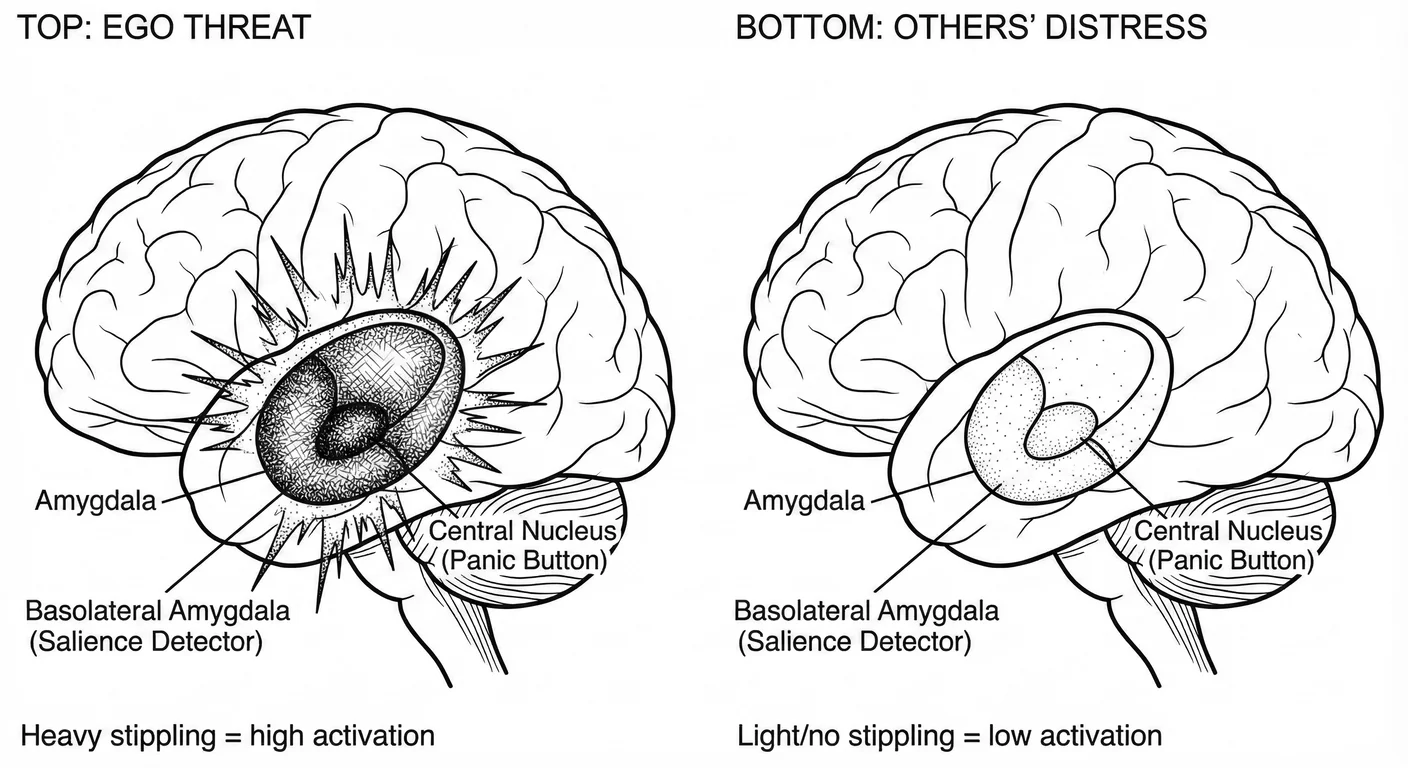
Close to the centre of the brain, in the core of the limbic system, lies the “alarm system” of our brain—the Amygdala Amygdala The brain's emotional processing center that governs fear responses and threat detection, often hyperactive in both narcissists and their victims. . But this characterisation, while evocative, undersells its role. We say “its” in the singular, but like most structures, the amygdala is paired, with one in each hemisphere of the brain, mirrored but performing the same role. Modern neuroscience used to think of the amygdala as a fear centre, an Alarm Bell for most purposes, and that is essentially correct. Ongoing research has uncovered its wider role, however, as a relevance detector. It is a system for rapidly evaluating whether incoming stimuli matter enough to warrant the body’s attention and resources. 1084
It works through two pathways. The first is direct from our sensory input which bypasses conscious processing entirely, activating threat responses in as little as 12 milliseconds. 715 The second winds through the scenic route of the front of the brain housing the palace’s throne room (executive centre), allowing for more nuanced evaluation. 715 In healthy functioning, these pathways work in concert with the palatial control systems: the amygdala flags what matters, the throne room decides what to do about it, and the palace Sentinel (anterior cingulate cortex) monitors for conflicts between the two and makes tactical adjustments. 973
What happens to this system in narcissism? Well, here the research grows more exploratory. Unlike the clear structural findings for the Translator (anterior insula)—where grey matter deficits correlate directly with reduced emotional empathy 1104 —neuroimaging studies have not identified consistent structural abnormalities in the narcissistic amygdala itself. 1104 910 The amygdala does not appear to be broken in the way one might expect from the dramatic emotional dysregulation narcissists display—and yet it behaves radically differently.
The problem is one of connectivity. Machine learning analyses of resting-state fMRI data have shown us that the amygdala is a key node in a distributed network that predicts trait narcissism. But it’s not the main factor; actually, the primary cause is in the functional connectivity between the amygdala and our executive decision making and emotional systems. 382
Higher narcissism scores correlate with altered communication patterns across this network, indicating that the amygdala is poorly integrated into the regulatory architecture that should modulate its outputs. 382 1052
This goes back to the findings earlier showing the narcissistic brain isn’t connected as well. It is not merely the structures themselves, but the links between them that are sometimes broken, and also how they operate and communicate.
In healthy brains, our amygdala tags emotional significance and passes this information upstream to the Throne Room areas, which then contextualise this significance and regulate our responses.
In narcissism, the wiring between these systems is frayed. The amygdala may function normally by itself, but its signals are either inadequately regulated by top-down Throne Room control or filtered through a self-recognition network that has become pathologically self-focused. 601 The alarm bell rings, but the system that should interpret its meaning and calibrate the response frankly has other priorities.
Narcissists show heightened emotional-executive network activation in response to ego threats and social rejection, 216 239 yet diminished responses when processing others’ emotional states. 370 The hardware may be intact; the problem lies in how these regions talk to each other—and in what the system has learned to treat as relevant. In this case, it is only truly alarmed by potential threats to its false self.
The Archivist: Hippocampus and the Fragmented Narrative
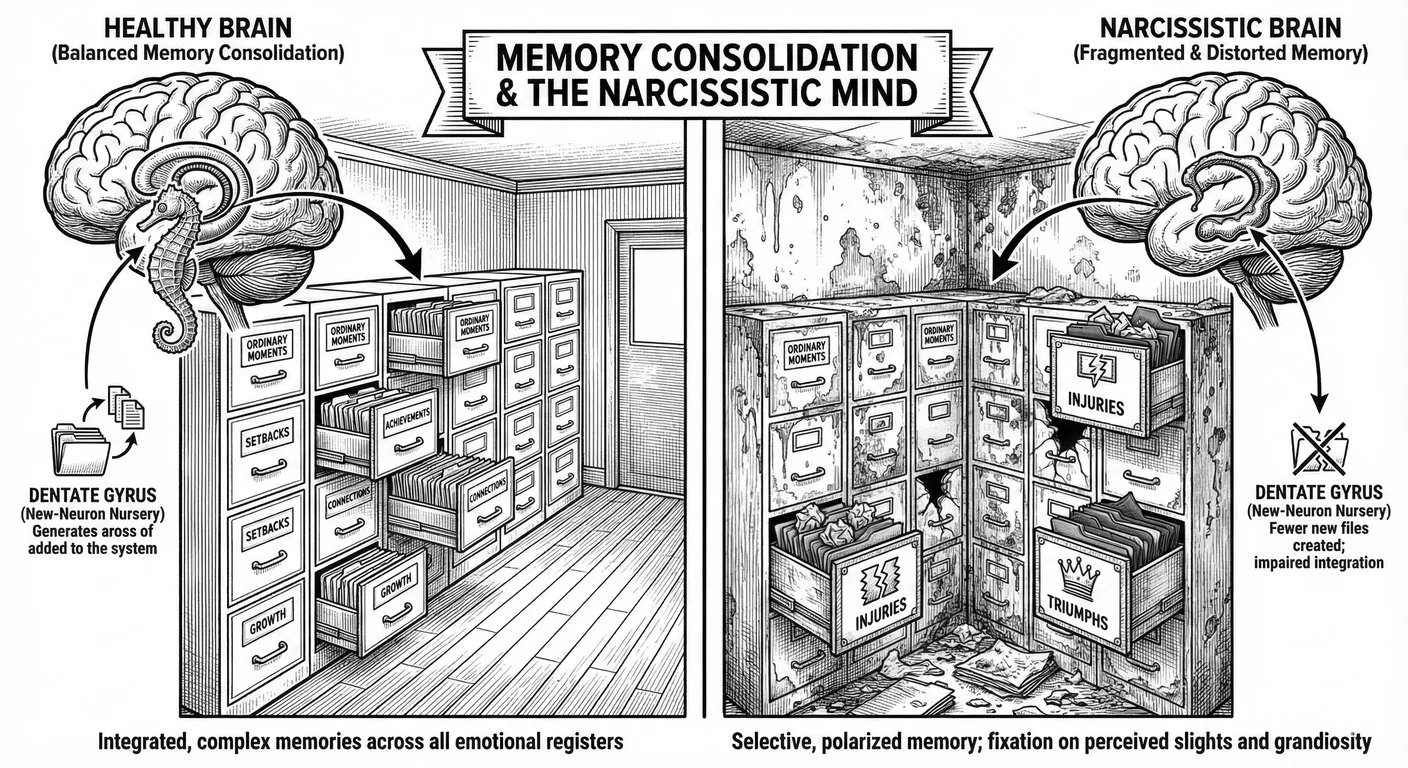
Beyond the Amygdala Amygdala The brain's emotional processing center that governs fear responses and threat detection, often hyperactive in both narcissists and their victims. lie two curled structures around the very centre of the brain. Like the almond-shaped amygdala, there is one in each hemisphere, and they resemble seahorses (being roughly the same shape and size). This is our Hippocampus Hippocampus The brain structure essential for memory formation and consolidation, often reduced in size by chronic stress and trauma from narcissistic abuse. —our Archivist—the brain’s primary memory formation region that turns short-term conscious experiences into long-term memories. The Archivist is the literal keeper of our memories.
The narcissist remembers only injuries and triumphs, with ordinary moments erased.
The archivist carefully catalogues all experiences. It works hard to actively weave them into a coherent narrative which then becomes our integrated life story. This is often why we have trouble with traumatic life events—it is hard to integrate them into our life story before they make sense. And sometimes we need help in understanding what happened to us, and why.
In its work, the Archivist files the ordinary moments alongside the extraordinary so that we can retrieve a complete life story, and so make sense of it. Our history thus provides us with a balanced view of the world, and also our place in that world.
It grounds us in the truth of reality, and being solid and coherent, our accurate and coherent memory enables us to reflect and explore our past clearly. We can get more information from reflecting on our memories. The Archivist is our portal into our past. In the narcissistic maze, however, the Archivist appears to work in a damaged archive: some vaults may be locked away and memories inaccessible, the indexing system haphazard and corrupted so that only extreme memories of triumph and vindictiveness can be readily accessed.
The hippocampus is astonishingly sensitive to stress hormones, particularly Cortisol Cortisol The body's primary stress hormone, chronically elevated during narcissistic abuse, causing widespread damage to brain structure and bodily health. , our stress hormone. Chronic early stress (the kind that shapes narcissistic development) literally shrinks the hippocampus. In NPD, episodic memory shows a characteristic pattern: vivid recall of narcissistic injuries and triumphs, but serious struggles with memory for ordinary moments of connection. 262
MRI studies have shown that adults with Cluster B traits (including but not limited to NPD) may have bilateral hippocampal volume reductions averaging 12–15% compared to healthy brains. This reduction appears to correlate with severity of childhood emotional neglect and adult deficits in autobiographical memory. The worse the childhood, the smaller the hippocampus tends to be. They may have thus lost access to large sections of their lives. 326
The Archivist is also necessary for pattern separation. We need the ability to distinguish between similar yet distinct experiences. In the narcissistic brain, this function is crippled. They cannot properly distinguish between past and present threats. It feels like what happened then is still happening now. This time fuzziness means they cannot distinguish between a prior rejection and a potential current one, nor between actual criticism and perceived slight. Every negative experience bleeds into successors, creating what researchers term “traumatic generalisation” 12 .
The Climate Controller: Hypothalamus
The narcissist’s incapacity for genuine connection has a specific biological address: the hypothalamus. Think of this pearl-sized control centre as the palace’s climate controller. In a healthy brain, this controller maintains comfortable equilibrium: hunger signals when to eat, fatigue when to rest. It also releases the bonding chemicals that make human connection feel rewarding.
In the narcissistic brain, however, the climate controller is broken. The internal climate lurches between extremes, either scorching hot or freezing cold. Bonding chemicals are released for the wrong triggers, or often not at all.
The Bonding Chemist (The Paraventricular Nucleus), responsible for synthesising oxytocin and vasopressin, shows altered function in narcissistic individuals. Here, the very biology meant to bond us to others is weaponised. Research reveals a paradox: when oxytocin—the “trust hormone”—is inhaled, it typically increases empathy. Yet in those with high narcissistic traits, it actually increases aggressive responses to perceived threats. 874 The chemist is mixing poison instead of glue.
The Clock (The Suprachiasmatic Nucleus) manages the circadian rhythms that guide our waking and sleeping lives. In NPD, these cycles are frequently disrupted. Unable to synchronise with the world’s natural rhythm, the brain exists in a state of temporal isolation, marked by delayed sleep phases and erratic wakefulness 236 .
The Drive Engine (The Lateral Hypothalamus) drives motivation and desire, but in the narcissist, incorrect calibration governs it. It revs high for status but stalls on connection. While power and admiration trigger massive surges of dopamine—lighting up the brain with reward signals—simple human intimacy fails to register on the dashboard. 633
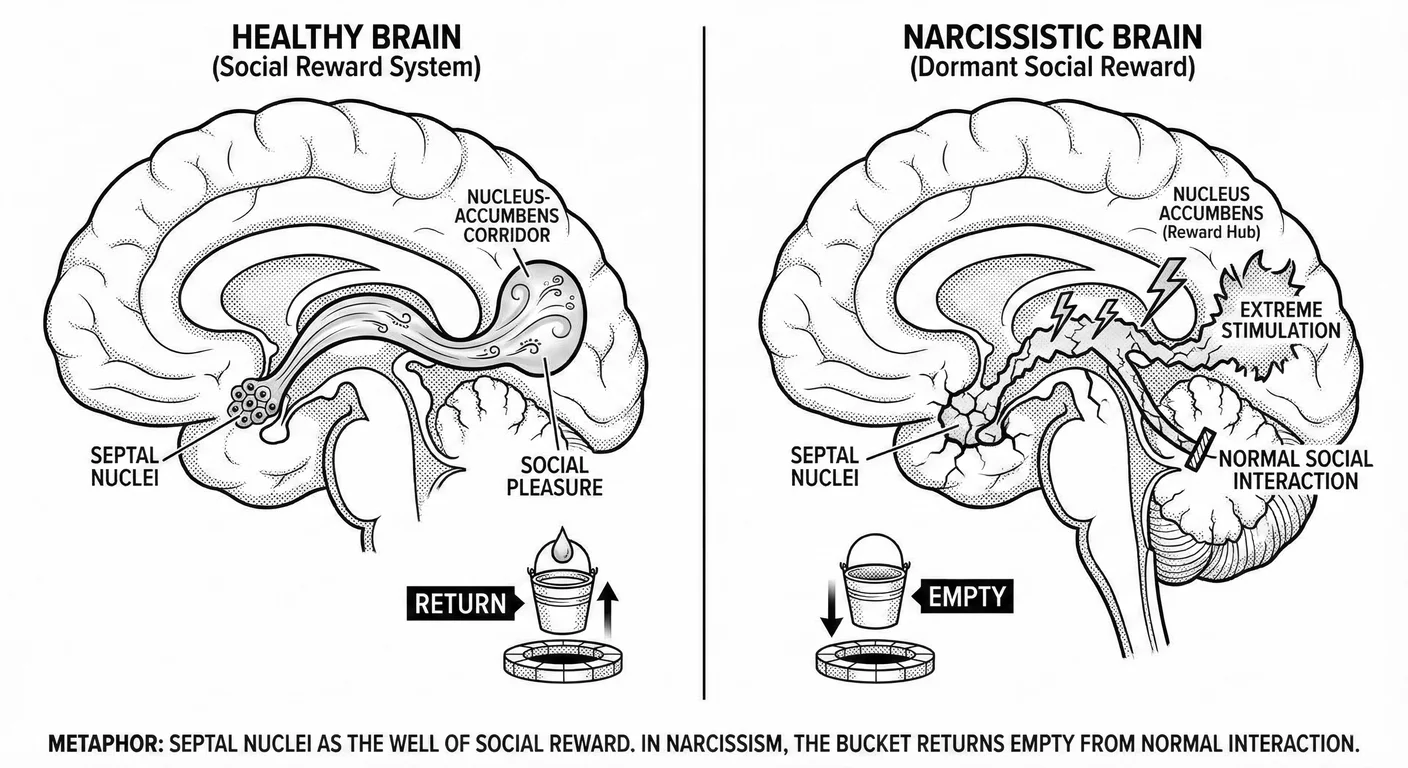
The Dry Well: The Septal Nuclei
Remember the dry well at the centre of the maze, where the wounded child hides? Hidden deep in the basal forebrain lies The Dry Well. These septal nuclei are the decision centres that regulate our pleasure, guide our social bonding, and control our aggression.
In most of us, this is the well from which contentment is drawn. A source of the warm glow we feel during genuine intimacy or the simple pleasure of being with friends. But for narcissists, as the name indicates, the well has run dry. The bucket descends and returns empty, again and again.
This region functions as the palace’s Social Thermostat (the lateral septum). Think of it as a diplomatic corps, deciding whether we approach others with an olive branch or a sword in hand. In NPD, this area goes dormant during positive interactions but becomes hyperactive when detecting threats. 1132 The machinery is primed for confrontation: ready for “animal rage” at the slightest insult, but at the same time chemically unable to process the warmth of peace.
The Broken Joy Corridor
The narcissistic brain fails at neural alchemy. The link between the septal nuclei and the brain’s reward hub (the nucleus accumbens) normally transforms social interaction into biological joy. In NPD, this corridor goes dark. And because the wiring is insensitive, the subtle electricity of a normal conversation cannot bridge the gap. To get a signal through, the system requires extreme voltage, in the form of intense admiration, dramatic recognised victories, or some sense of domination. 320 The narcissist’s hardware is simply too resistant to register you, and so they are bored because they cannot recognise the worth of the people around them.
The Missing Receivers
Even if we could send the perfect signal of love, the narcissistic brain lacks the ports to receive it. Post-mortem studies suggest a reduction in oxytocin receptor density in these regions. 592 We can pour love and validation into the well, but without these “docking stations” the signal may be lost in the void. The result is narcissistic anhedonia—a desperate, almost manic pursuit of stimulation because normal life feels like nothing at all.
The Caregiver’s Circuit
The Well’s role in maternal instinct yields perhaps the most chilling insight. Brain scans shocked researchers: parents with NPD show reduced activation here when viewing their own children’s faces, compared to photos of themselves. 925 Neural hardware that should prioritise offspring over false self-image has broken. The brain lights up only in recognition of the self—not with the instinct to nurture.
The Jammed Radar & Dominance Switch
Why the obsession with hierarchy? The Well also functions as a Social Radar, constantly scanning the room to balance approach and avoidance. In NPD, this radar signals “Danger” during safe intimacy, yet signals “Safety” in exploitative relationships. 486
Furthermore, specific neurons in the Well encode social dominance. In the narcissist, this switch is jammed in the “on” position, suppressing the neurons responsible for cooperation. 115 The brain is chemically locked into a vertical struggle for status because the horizontal circuitry for connection is offline.
At the same time, the NPD brain’s “metronome”—the theta rhythms that coordinate emotional processing—is out of sync. 184 Without a “conductor” to unify the orchestra, they cannot harmonise their internal state with the people around them.
The Evidence for Intervention
We know this “dry well” sources social warmth because, historically, we have turned it on manually. In 1963, Dr. Robert Heath famously applied electrical stimulation to a patient’s septal area, who immediately reported feeling “like I love everyone.” 537 More recently, deep brain stimulation in this area for depression has increased empathy and reduced self-focus. 1091 The deficit is mechanical. The capacity for love is broken—lost behind neural hardware malfunction.
The Tuner: Cerebellum and Social Calibration
Long dismissed as merely the brain’s motor control centre, the cerebellum—the “little brain” tucked beneath the occipital lobes—has emerged as a player in emotional regulation, social cognition, and the prediction of social outcomes. Think of it as the palace’s orchestra conductor, or more precisely, the Tuner, who ensures every instrument plays at the right pitch and volume. Reality is wonderfully fine-grained, so the Tuner constantly adjusts: softening what is too loud, amplifying what is too quiet. Unfortunately, the Tuner’s work is either absent or broken in NPD. Emotions blast at full volume when they should whisper; social responses are pitched wrong, creating a stark contrast around narcissistic behaviours that ironically forces those around them to make sense of why they are so discordant, not realising it is actually neurological damage. The overall performance is “off,” despite their absolute grandiose belief in their social talents.
The cerebellum is an innovation of nature and neurology: despite being a fraction of the size, it contains more neurons than the rest of the brain combined. 545 Its main neurons, Purkinje cells, each receive input from up to 200,000 other neurons—far more than any other neuron type. This gives the “little brain” the massive computational power required for fine-tuning behaviour. These abilities are not restricted to movement but also extend to predicting and fine-tuning all aspects of our behaviour, especially emotional and social responses. The brain considers the pattern of almost all our senses, finding rhythms, beats, chords and so on, finding the melodies that play throughout our lives, and fine-tuning them for harmony. Sadly, in the narcissistic brain this fine-tuning mechanism is impaired.
Consider the research on “Cerebellar Cognitive Affective Syndrome,” first described in patients with cerebellar lesions. The symptoms bear strong resemblance to narcissistic traits: impaired social interaction, disinhibited behaviour, and difficulty with emotional regulation. 1092 The cerebellum shapes personality more than we appreciate.
Confirmation comes from MRI scans of NPD patients showing reduced grey matter volume in the back of the cerebellum where the Social Predictors live. They typically power social prediction and mentalising and are usually connected to prefrontal (executive throne room) and parietal association areas (which organise mental faculty co-operation). 1191 These regions are part of the brain’s social cognition network, and their atrophy correlates with the severity of empathy deficits and social dysfunction.
The cerebellum anticipates for us. It does this by prediction and error correction. It keeps creating internal models of expected outcomes and quickly adjusts them when reality diverges from prediction. We effectively live multiple lives in parallel, and it picks between them in each moment. This textures every moment with possibility, tension, relief, anticipation, and a host of other refined sensations. In social interaction, the cerebellum helps predict others’ responses and adjusts behaviour accordingly. This powers joke-telling and what we colloquially call “sense of humour.” In NPD, atrophy and disrupted communication impair this predictive mechanism. Accurately predicting others’ emotional responses becomes harder, leading to characteristic social missteps and compensatory grandiosity. 1157
NPD also alters functional connectivity between the cerebellum and the outer layers of the brain (the wrinkly cerebral cortex). The loops powering real-time adjustment of social behaviour (called cerebellar-thalamic-cortical loops) are nowhere near as well connected as in healthy brains. This appears most clearly between the cerebellum and the mentalising network. 512 Without this fine-tuning, narcissistic social behaviour becomes coarse, feeling exaggerated—performed rather than felt.
Narcissistic rage highlights the cerebellum’s role in emotional regulation. The vermis (Latin: “worm”)—which we will call the Emotion Dampener—regulates emotional intensity through connections with the emotional (limbic) system. In narcissists, the vermis shows alarm during ego threat and fails to dampen emotional responses. 1192 The little pathway that should smooth emotional spikes instead amplifies them.
Direct current applied to the cerebellum can temporarily improve emotional recognition and reduce aggressive responses to ego threat in individuals with narcissistic traits. 385 Cerebellar dysfunction in NPD may embody an ongoing regulatory failure—one that, at least in theory, can be corrected. However, we must temper our expectations: artificially pumping electrical signals into specific brain regions brings them back online only temporarily.
The cerebellum also contributes to our sense of agency: the feeling that we are the authors of our actions. Through precise timing of motor predictions and sensory feedback, it forges the smooth experience of voluntary control as we shape our intents to our actions, which are themselves shaped by our surroundings. For narcissists, their disrupted cerebellar timing may contribute to the external locus of control and the tendency to blame others. 125 Their actions do not feel fully owned, and because the predictive timing is off, responsibility is easily displaced to others. This raises the question of how much agency they actually feel.
The discovery of closed-loop circuits between the cerebellum and our Hippocampus Hippocampus The brain structure essential for memory formation and consolidation, often reduced in size by chronic stress and trauma from narcissistic abuse. means memory is also affected. These circuits, involved in spatial navigation and episodic memory, show altered activation during autobiographical recall. 1304 The faulty cerebellum in NPD may contribute to characteristic distortions of personal history, smoothing some memories while amplifying others to maintain the grandiose narrative around the false self.
The cerebellum is larger in males relative to total brain volume. This may partially explain gender differences in NPD presentation, with males showing more overt grandiosity while females display more vulnerable narcissism. 294 The cerebellar contribution to narcissistic expression may differ between the sexes. This touches on the diagnostic discrepancies discussed in earlier chapters.
Language suffers too. Cerebellar patients show weakness and difficulty controlling speech muscles (dysarthria) and subtle alterations in language pragmatics—the social use of communication. Narcissists characteristically show similar alterations: the verbose, self-referential speech patterns that exhaust listeners. 801 The cerebellum that should regulate conversational turn-taking instead permits the monologue.
Part III: The Grand Chambers—Higher Functions and the Constructed Self
The cortex—the folded outer layer of the brain where sensation becomes perception and emotion meets thought—forms the palace’s Grand Chambers. In the narcissistic maze, these become upper galleries where mirrors multiply reflections and windows show only distorted self-images.
The Mapmaker: Parietal Lobes and the Spatial Self
The brainstem deals with threshold conditions. Where does your body end and another person begin? This seemingly simple question will stump many narcissistic individuals. The answer comes from our parietal lobes—the palace’s Mapmaker. These stretch over the upper rear portions of the brain. They are always busy constructing our sense of body in space and our self in relation to others—two very different and yet highly interdependent faculties.
In the healthy brain, the Mapmaker draws accurate charts: here is where I end and here is where you begin; here is how we exist in relation to each other. These maps update continuously as we move through social space, tracking the boundaries between bodies with a precision we never consciously notice. 107
In the maze, the maps are drawn differently. Based on the censored, distorted, intermittent information it receives from the rest of the brain, it places the false self at the centre of every chart. All other territories are either empty wilderness or extensions of the homeland.
This requires projecting a self that is simultaneously expansive and fragile. If others don’t buy the facade, a threat of invasion and annihilation hangs over everything.
The Mind Reader
The Mind-Reader (the inferior parietal lobule) powers Theory of Mind—the ability to understand that others have thoughts and feelings different from our own. Within this region lies the Perspective-Taker (angular gyrus), handling semantic processing and mentalising. Neuroimaging studies reveal a telling asymmetry: narcissists show reduced activation during tasks requiring empathy for others, but the same region lights up when considering what others might think about them. 1088 The hardware for perspective-taking exists. It simply runs different software—calibrated for reputation management rather than genuine curiosity about other minds.
Boundary Drawer
The Boundary Drawer (the superior parietal lobule) integrates sensory information to create a coherent body image and tracks the distinction between actions we perform and actions we observe. 296 In NPD this region shows a paradox. During tasks requiring self-other distinction, it fails to discriminate cleanly—as if the boundary between self and other is simultaneously too rigid and too permeable. 153 This explains the narcissist’s contradictory relationship with others: consuming them (treating partners, children, employees as extensions of the self) while fearing consumption (defending against any perceived intrusion with territorial rage).
Self-Other Divider
The Self-Other Divider (the temporoparietal junction or TPJ), where temporal and parietal lobes meet, functions as a hub for distinguishing self from other and for moral reasoning. 1088 When researchers temporarily disrupted this region using magnetic stimulation, something unexpected happened: narcissistic defences weakened. 1354 Participants became temporarily less defensive about self-image and more able to consider others’ perspectives. The finding suggests the TPJ actively works to maintain the false self barrier—not a passive deficit but an ongoing construction project, the brain expending energy to keep the walls up.
The Interpreter: Temporal Lobes and Social Perception
The temporal lobes serve as the palace’s Interpreter—who converts the raw signals of social life into meaning. Running along the sides of the skull, they work on social meaning and facial recognition: the facts and concepts that define our understanding of self and our world. The Interpreter usually translates faithfully. It conveys what other people mean by their expressions, analysing their tones, and the structure and nuance of their words. For narcissists, the Interpreter is biased. Again, it translates everything through the filter of self-relevance—ignoring nuances and often mishearing tones, projecting shadows of threats or potential tribute where neither actually exists.
Social Cue Reader
The Social Cue Reader (the superior temporal sulcus or STS) is actually on a groove along the upper temporal lobe that responds to biological motion. It tracks gaze direction and decodes facial expressions. Though attuned to social cues, it shows reduced activation in narcissists when they see others’ emotional expressions, especially subtle ones. 22 They actually see less in others’ faces, thereby missing the micro-expressions that for the rest of us convey genuine feeling.
Face Recogniser
The Face Recogniser (the fusiform face area or FFA) is specialised for one task: rapid face recognition. Damage here causes face blindness (prosopagnosia). Oddly, narcissists have enhanced activation for self-face recognition, but this is reduced for the faces of familiar others. 632
Social Script Keepers
The Social Script Keepers (the temporal poles) represent the frontmost tips of the temporal lobes. They integrate emotional and social information, thereby creating complex social concepts. Again, these show reduced volume through atrophy and disrupted connectivity in individuals with NPD. 934 These regions store social scripts, integrating past experience into current behaviour. Their dysfunction contributes to the jarring social awkwardness often hidden beneath narcissistic bravado.
The Hall of Mirrors: Occipital Lobes and Visual Self-Focus
Watch a narcissist at a restaurant: their gaze drifts to the window, checking their reflection. Past a shop front, a sideways glance at the glass. Seated across from you at dinner, their eyes slide to the dark screen of their phone, angled just so. Not vanity in the ordinary sense—a neurological compulsion, rooted in the visual processing centres at the back of the brain.
The occipital lobes transform photons into meaning. In the healthy brain, this visual processing serves the world: identifying faces, tracking movement, building a coherent picture of the environment and the people in it. In the narcissistic maze, the Hall of Mirrors has been installed. Every surface reflects the self; every window has been silvered over; every vista leads back to the same face.
The primary visual cortex—V1—shows normal processing of basic visual features in NPD. But as visual information flows through the ventral (“what”) stream towards the temporal lobes and the dorsal (“where”) stream towards the parietal lobes, narcissistic distortions emerge. 474
The Ventral Stream, handling object and face recognition, shows the asymmetry from the start. The First Face Processor (the occipital face area) already privileges the self-face over others. 996 This bias compounds as information flows towards the Face Recogniser, creating a cascade where the self-face becomes progressively more vivid while others fade into neural background.
Individuals with NPD show activation in face-processing regions even when viewing objects associated with the self—their car, their home, their possessions, even their brands—as if these objects have become extensions of their own face. 445 The visual system has literally learned to see the self everywhere, transforming the entire visual world into a mirror.
The other Dorsal Stream, processing spatial relationships and action, shows very different alterations. The Motion Tracker—V5/MT—shows enhanced activation when viewing self-motion in mirrors or videos but reduced activation to others’ biological motion. 498 The narcissistic brain is specifically tuned to its own movement through space while remaining relatively blind to the motion of other bodies around it.
The Object Recogniser (the lateral occipital complex) demonstrates what researchers term “narcissistic object cathexis” at the neural level. Cathexis means the concentration of mental energy on one particular person or idea, one object (especially to an unhealthy degree)—somewhere between fixation and obsession. Objects owned by the narcissistic self show enhanced activation compared to identical objects owned by others. 494 This extends even to virtual objects in a computer game.
Visual imagery, generated by top-down activation from prefrontal areas, is particularly vivid for self-aggrandising fantasies in NPD. 681 During grandiose fantasy, the occipital lobes show activation patterns similar to actual perception, but with even greater intensity. The narcissistic brain’s visual system creates internal films of glory actually more vivid than reality itself. Tell a narcissist an epic story where they are the star, and they literally lose track of reality and time as they begin imagining it.
Finally, the phenomenon of “narcissistic gaze detection” reveals a paranoid occipital alteration. The upper temporal sulcus and occipital regions usually work together to detect when others are looking at us. In NPD, this system is especially active, often detecting gaze when none exists. 967 The narcissistic individual feels watched even when alone, the visual system reflexively creating an audience where none exists to preserve a minimum level of supply.
Recent studies using decoded neurofeedback have shown that training individuals to reduce occipital cortex activation to self-images can temporarily reduce narcissistic responses. 629 The visual dominance in NPD appears maintained by ongoing neural activity. The mirror can be covered, even if it cannot easily be removed.
The Sentinel: Why Rejection Feels Like Physical Pain
Criticism hurts because of the brain’s anterior cingulate cortex (ACC)—the palace’s Sentinel. (Note: This is distinct from the Sentry of the brainstem, which handles raw arousal; the Sentinel handles higher-level conflict and emotional pain). This region detects conflict, processes pain, and registers social suffering. It processes social pain through the same circuits that process physical pain. Rejection literally hurts.
In the healthy mind, the Sentinel raises appropriate alarms: for genuine contradictions, real errors, or actual threats. For narcissists, the Sentinel is exhausted from constant vigilance. It treats every social signal as a potential injury and conflates criticism with failure and danger.
The simple act of receiving feedback that does not match self-perception generates a neural storm lasting long after the feedback has ended. 142 The narcissistic brain shows hyperactivation to anticipated rejection but paradoxically becomes numb to actual rejection—a pattern that may reflect the defensive deactivation of attachment systems in response to abandonment. 356
The Sentinel also shows altered “prediction error” signalling—the brain’s way of updating expectations. 565 Negative surprises (when outcomes are worse than expected) generate exaggerated signals, while positive surprises are diminished. Relief is less important than potential loss. The brain becomes better at detecting disappointment than joy, criticism instead of praise.
The Translator: Anterior Insula and the Failure to Feel
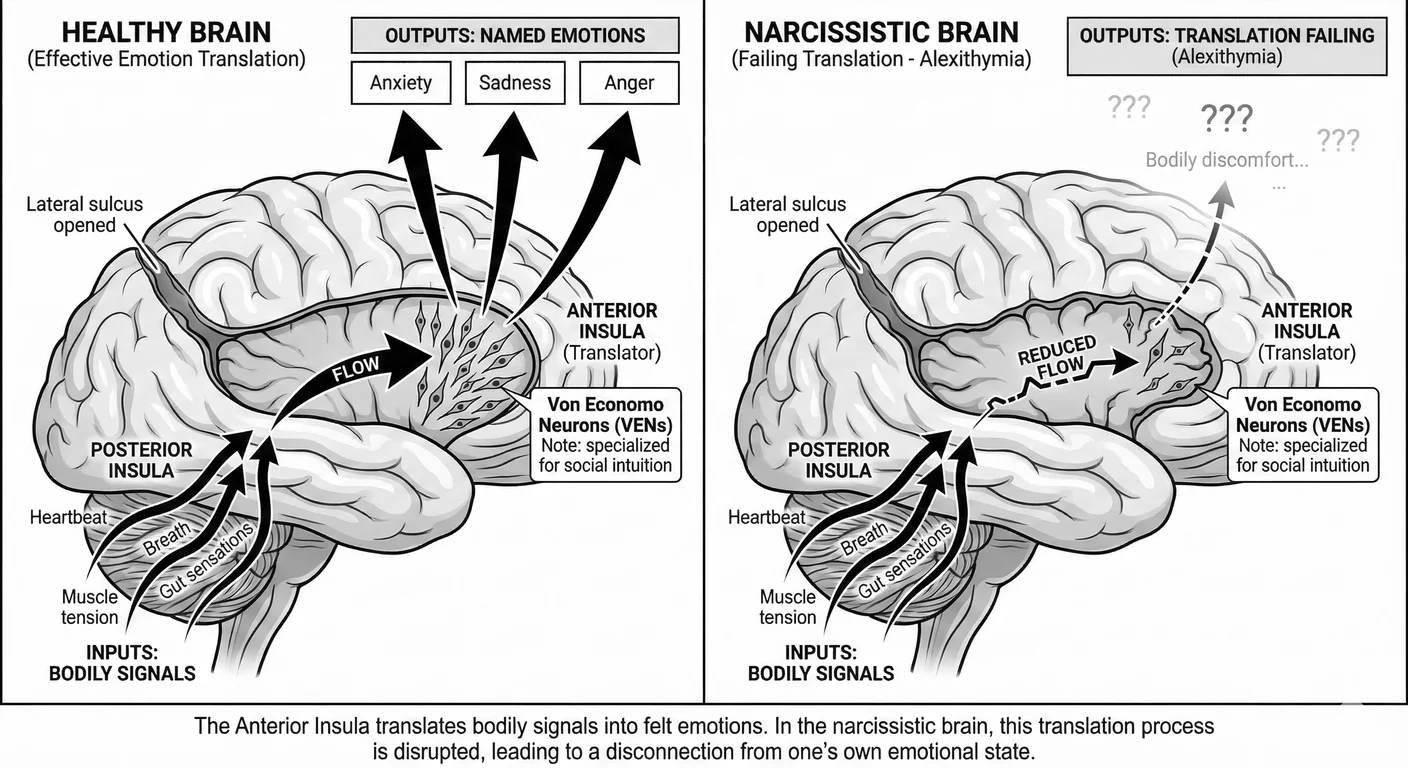
Hidden within a deep fold of the cortex lies perhaps the most important structure for understanding narcissistic empathy failure: the Anterior Insula Anterior Insula A brain region crucial for self-awareness, empathy, and processing emotions—showing reduced activity in narcissists when processing others' suffering. . This is the Translator, buried within the lateral sulcus (the deep cleft separating temporal and frontal lobes), serving as the bridge between body and mind. If the Sentinel monitors for threats and the Mapmaker charts our social world, the Translator performs an even more fundamental task: it converts the body’s internal states into feelings. Without this translation, one can have a racing heart without feeling anxious, tears without feeling sad, or clenched fists without feeling angry. The body speaks, and the brain hears, but the mind cannot listen.
The anterior insula generates what the neuroscientist A. D. Craig calls “the material me”—that subjective sense of a physical self that feels emotion in real time. 273 This translation occurs through accessing our “inner space” (interoception): the awareness of signals arising from within the body itself. These include but are not limited to our heartbeat, breathing, gut sensation, muscle tension, temperature, and pain. The posterior (rear) insula receives these raw physiological signals, and then the anterior (front) insula weaves them into coherent feeling states.
Racing heart plus tight chest plus shallow breath becomes “anxiety.” Heavy limbs plus slow thoughts plus chest ache becomes “sadness.” The translation is so smooth in healthy brains that we forget it happens at all—we simply feel.
This translation depends on a remarkable cellular architecture. The anterior insula contains a rare type of neuron found only in highly social species: Von Economo neurons (VENs). These are large, spindle-shaped cells found only in the anterior insula and anterior cingulate cortex of humans and other highly social mammals (great apes, whales, dolphins, elephants).
These cells enable the rapid integration of social and emotional information. 23 VENs link the anterior insula directly to the anterior cingulate cortex, creating a fast pathway enabling social intuition. They are the cellular hardware of social intuition—the brain cells which allow a “gut feeling” to guide behaviour before conscious deliberation.
In narcissistic personality disorder, this Translator is also badly broken. As we saw in earlier chapters, MRI studies reveal significantly reduced grey matter volume in the anterior insula of individuals with NPD. 1104 This is hardware damage beyond mere software malfunction—actual tissue reduction in the structure responsible for translating body states into feelings. This region has atrophied through prolonged lack of use.
The deficit correlates directly with reduced emotional empathy: the smaller the anterior insula, the less capacity the individual retains for feeling what others feel.
The structural deficit explains the central issue of narcissistic empathy. Empathy requires simulation: to understand others’ pain, one’s brain must generate a shadow of that pain in one’s own body-sensing regions.
When one sees someone suffer, the anterior insula activates as if the observer is suffering themselves, a process called embodied simulation. 370 Witnessing distress can feel physically uncomfortable because the insula is literally simulating a version of what the other person feels. The simulation is directly observable in the winces and micro-expressions of healthy empathy.
In narcissism, the simulation just doesn’t happen. Functional imaging studies show that individuals with high narcissistic traits display reduced activation—or abnormal firing patterns—in the right anterior insula during empathy tasks. 370 They see someone crying but don’t feel any corresponding somatic echo. The information arrives (“she is crying”) but the translation fails (“I feel her sadness”).
Clinicians observe cognitive empathy without emotional resonance: the narcissist can identify that the other person is sad, and can even articulate why they might be sad, but remains physically numb to that sadness. They know, but do not feel.
These structural changes are not caused solely by early relational trauma. Chapter will examine mounting evidence that digital technology exposure during development can induce similar grey matter reductions in the anterior insula—the same Translator damage, produced by a different sculptor. In that case: wider society.
The translation failure extends inward as well as outward. Because the anterior insula fails to convert bodily stress into clear emotional signals, many individuals with NPD experience Alexithymia Alexithymia Difficulty identifying, describing, and processing one's own emotions—often present in narcissists and sometimes developed by abuse survivors. —difficulty identifying and describing even their own emotions.
The same study linking narcissism to insular dysfunction found elevated scores on the Toronto Alexithymia Scale, the standard measure of emotional blindness. 370 Without the Translator, stress registers as diffuse physical agitation rather than nameable emotion. The narcissist knows something is wrong—the body is screaming—but cannot identify what.
This alexithymia offers a deeper insight into narcissistic rage. When emotion cannot be named, it won’t be regulated. The unprocessed arousal builds like pressure in a sealed vessel until it must discharge explosively. What appears as disproportionate fury is the available outlet for physiological activation that has no other natural path to expression. They do not know what they feel, so they explode to release the pressure. The rage is seldom about what triggered it. It is about years of accumulated sensation that was never translated into feeling, never processed, and never released through normal, healthy emotional channels. It is animal and unmodulated.
The anterior insula also anchors one’s sense of time passing and the human experience of the present moment. Its dysfunction in NPD contributes to the temporal distortions discussed in earlier chapters: the inability to inhabit the present, the constant pull towards past grievances and future triumphs, and the sense that ordinary moments pass without registration while self-relevant moments stretch or compress unpredictably.
Part IV: The Throne Room—Executive Control and the Exhausted Ruler
At the very front of the cortex, directly behind the forehead, we reach the brain’s executive suite—the Prefrontal Cortex Prefrontal Cortex The brain region behind the forehead governing executive functions, impulse control, and emotional regulation—often structurally or functionally different in narcissists. , the palace’s Throne Room. This part of our brain is what makes us distinctly human. It is capable of planning, abstract thought, our moral reasoning, and our self-control.
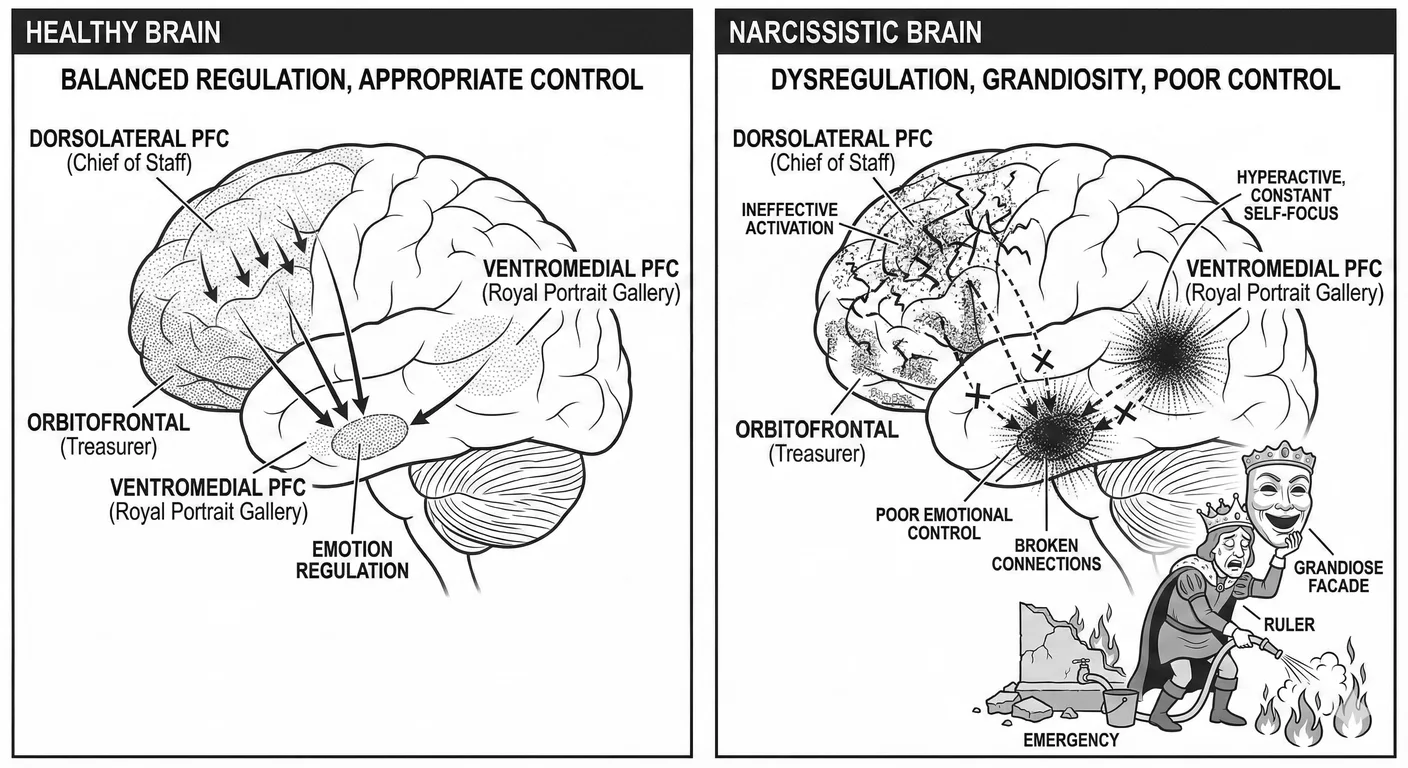
In the healthy mind, this Throne Room houses a wise ruler who coordinates the palace staff, listens to advisors, and governs with appropriate authority. In the narcissistic maze, the Throne Room is occupied by a ruler under siege—constantly firefighting emotional emergencies from below while maintaining the grandiose false self above. The coordination is impaired. The system lacks information due to censoring, suffers from disconnection, and substitutes hardened scripts for genuine flexibility. This is where conscious awareness is supposed to live, and where the hollow core of narcissism is most keenly felt.
The Chief of Staff: The Logical Brain
The outer throne room—anatomically the dorsolateral prefrontal cortex (DLPFC)—functions as the ruler’s Chief of Staff. Located on the outer upper surface of the frontal lobe, this Aide maintains the schedule for the ruler, tracks ongoing tasks, and coordinates complex operations.
In the healthy palace, this Chief of Staff works efficiently, keeping multiple matters in mind while flexibly responding to changing circumstances. In the narcissistic maze, the Chief of Staff struggles: maintaining working memory, enabling what cognitive flexibility remains, and exercising top-down control over behaviour that constantly threatens to fragment. Rigid control substitutes for true flexibility.
Working memory tasks combined with emotional distractors reveal the Chief of Staff’s struggle in NPD. When maintaining neutral information, individuals with narcissistic traits show normal activation. But introduce self-relevant emotional content—a critical face, a word like “failure”—and this region becomes erratic, sometimes hyperactive in attempted suppression, sometimes failing entirely. 305
The Chief of Staff normally inhibits the Alarm Bell (amygdala) during emotion regulation. In narcissistic individuals, this connection is weakened or absent. The executive cannot properly manage the emotional staff, leading to the emotional dysregulation characteristic of narcissistic injury. 930
Brain stimulation studies have provided causal evidence for this dysfunction. 1085 Enhancing the Chief of Staff’s activity temporarily reduces narcissistic responses and increases empathic accuracy. The palace’s executive function can be temporarily restored, suggesting that narcissistic patterns are maintained by ongoing neural dysfunction rather than fixed structural damage.
The Treasurer: Orbitofrontal Cortex and Distorted Values
The orbitofrontal cortex (OFC), located just above the eyes, functions as the palace’s Treasurer—the official who assigns worth to experiences and determines what holds value and what proves worthless.
In the healthy palace, the Treasurer maintains accurate accounts: connection and achievement are valued in appropriate measure. In the narcissistic maze, the Treasurer operates with counterfeit currency: self-enhancement is overvalued, genuine connection is undervalued, and the accounts never balance.
The Praise Appraiser (the medial orbitofrontal cortex) evaluates the subjective value of rewards. It shows hyperactivation in narcissistic individuals when receiving praise or achieving status-related rewards. 947 But this activation is short-lived, requiring ever-greater stimulation to achieve the same neural response—a neurobiological tolerance that drives the endless pursuit of validation.
The Strategy Changer (the lateral orbitofrontal cortex) enables reversal learning and behavioural flexibility. It shows reduced activation when narcissistic individuals need to change strategies. 1094 Once a behaviour correlates with self-enhancement, the narcissistic brain struggles to unlearn it, even when it becomes maladaptive. The maze’s passages, once carved, cannot easily be redrawn.
Recent neuroeconomic studies have revealed that the OFC in narcissistic individuals shows altered temporal discounting, the tendency to devalue future rewards relative to immediate ones. 625 Specifically, self-enhancing rewards show reduced temporal discounting (maintaining value over time) while social rewards show increased discounting (rapidly losing value). The narcissistic brain literally values future admiration over present connection.
The Royal Portrait Gallery: The Emotional Self
The inner portion of the prefrontal cortex—anatomically the ventromedial prefrontal cortex (vmPFC), located in the middle lower portion of the frontal lobe—is the palace’s Royal Portrait Gallery.
This is the chamber where the ruler’s image is maintained, where self-concept is constructed and preserved. Here we think about ourselves, evaluate our characteristics, and maintain our sense of continuous identity. In the healthy palace, the gallery contains honest portraits: achievements and failures, strengths and weaknesses, a realistic image that can be updated as life unfolds. In the narcissistic maze, this gallery has become an obsession—constantly lit, constantly attended, but containing only flattering portraits while unflattering ones are slashed or hidden. The neurobiological equivalent of a hall of mirrors: constantly active, constantly reflecting, but showing only distorted images.
The Portrait Gallery in individuals with NPD shows sustained hyperactivation during rest. 879 The narcissistic brain never stops thinking about itself. This constant self-focus consumes energy that would typically be available for other cognitive processes, potentially explaining the cognitive inflexibility often seen in NPD.
During self-referential tasks (when asked to judge whether trait words describe themselves) narcissistic individuals show not just increased Portrait Gallery activation but altered timing. 922 The activation begins earlier (heightened readiness for self-focus), peaks higher (more intense processing), and persists longer (difficulty disengaging). Each moment of self-reflection transforms into a neural event of unusual intensity and duration.
The Portrait Gallery normally works in concert with the brain’s daydreaming network (the Default Mode Network), but in NPD, this coordination is disrupted. Instead of smooth oscillation between self-focus and external attention, the narcissistic brain shows fragmented activation, as if different parts of the self-system are working at cross purposes—a fragmentation that may underlie the sense of inner emptiness despite outward grandiosity. 1021
Conclusion: The Architecture Revealed
The narcissistic brain’s architecture runs from the ancient brainstem structures that regulate arousal, through the limbic system where emotion and memory intertwine, to the prefrontal cortex where self-concept is constructed and maintained. The Palace has been revealed as a Maze: the same structures present in every human brain, but developed differently, connected differently, functioning differently.
When the Alarm Bell fires to ego threats as if to mortal danger, the Archivist encodes only the extremes while ordinary reality fades. The Dry Well cannot register connection’s warmth, even as the Mind-Reader processes others as audience rather than separate minds. Sensation fails to become feeling through the damaged Translator, while the Exhausted Ruler firefights constantly—all resources diverted to the Portrait Gallery’s endless demands.
These are not metaphors imposed from outside. They are descriptions of measurable neural differences documented through decades of neuroimaging research. The narcissistic brain is not choosing its dysfunction any more than it chose its development. The maze was built, stone by stone, synapse by synapse, in response to early environments that made these adaptations necessary for survival.
The neural networks connecting these structures and the neurochemistry enabling their communication reveal how the Alarm Bell and the Portrait Gallery coordinate their hypervigilant operations, what chemical messengers carry signals through the maze’s twisted passages, how development went awry, and whether repair remains possible.
*For detailed analysis of how this neural architecture manifests in observable behaviour patterns, see Chapter
Continue reading "Inside the Brain"
Get the complete book with all 21 chapters, plus PDF and EPUB downloads for offline reading.
One-time purchase. No subscription required.
Enjoying the book?
Get the complete book with all 21 chapters in PDF and EPUB formats.
Buy Now – $12.99