% Backward compatibility alias
This is a practical reference for recognising narcissistic patterns and responding effectively. Use the tables to identify what you’re facing; use the interventions to protect yourself.
For foundational tactics (Grey Rock, BIFF, no contact, co-parenting), see Chapter . For recovery, see Chapter .
Why Standard Advice Fails
Standard relationship advice—“use I statements,” “find compromise,” “try couples therapy”—assumes software problems: misunderstandings fixable through better communication.
Narcissistic personality disorder involves hardware problems. The brain structures for empathy are atrophied. 1104 The circuits for updating behaviour based on feedback malfunction. 910 The networks that should shift from self-focus to external engagement are locked. 370
You cannot talk someone into empathy when the neural architecture for empathy is gone.
These interventions work because they bypass these deficits rather than appealing to them. Core insight: stop trying to change their worldview; protect yourself from their limitations.
Neural Architecture Reference
Quick reference for brain structures driving narcissistic patterns.
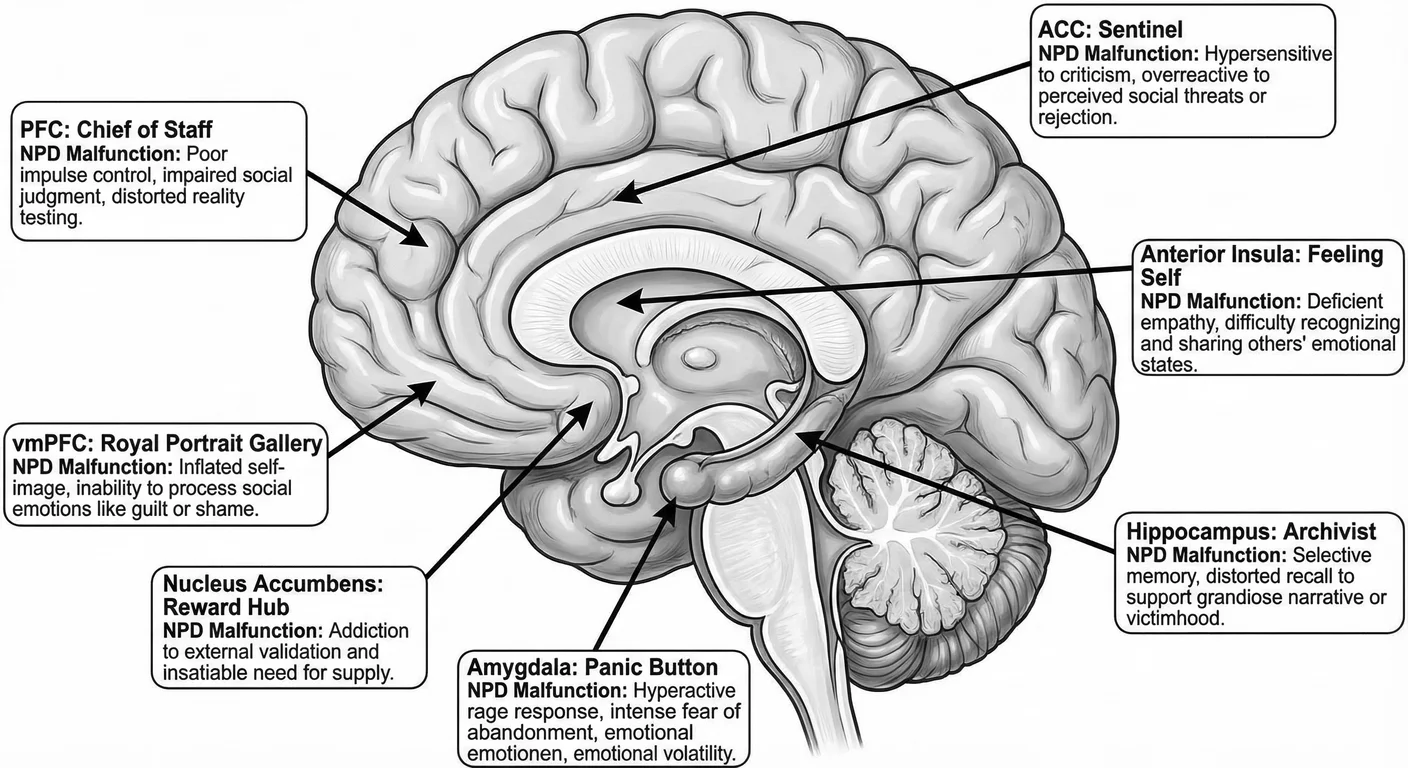
Master reference: Neural structures underlying narcissistic patterns
Nickname | Structure | Function and NPD Malfunction | | — | — | — | Royal Portrait Gallery | vmPFC | Self-concept. NPD: Hyperactive; grandiosity feels ordained | Feeling Self | Anterior insula | Body signals to emotions. NPD: Reduced; others invisible | Sentinel | ACC | Threat monitoring. NPD: Criticism = survival threat | Treasurer | OFC | Updates from feedback. NPD: Cannot update; repeats failures | Reward Hub | Nucleus accumbens | Reward processing. NPD: Needs extreme stimulation | Reward Weigher | Striatum | Anticipates rewards. NPD: Tolerance develops | Self-Reflector | PCC | Self-relevant info. NPD: Amplifies positive, suppresses negative | Self-Referential Prison | DMN | Self-reflection. NPD: Cannot shift from self-focus | Emotional Mirror | Mirror neurons | Resonance with others. NPD: Selective; drives splitting | Social Cue Reader | STS | Reads expressions. NPD: Reduced; misses micro-expressions | Archivist | Hippocampus | Memory. NPD: 12–15% reduced; fragmented autobiography | Panic Button | Central amygdala | Threat response. NPD: Chronic arousal; full-body rage | Braking System | GABA system | Impulse inhibition. NPD: Reduced; cannot brake rage | Bonding Chemistry | Opioid system | Attachment. NPD: Praise = release; removal = withdrawal |
Reading the Patterns
Each trait maps to specific neural alterations. When you understand the source, confusing behaviour becomes predictable.
Grandiosity
Grandiosity emerges from hyperactive self-referential circuits. The vmPFC (Royal Portrait Gallery) spotlights the self constantly. The mOFC (Praise Appraiser) spikes on praise but builds tolerance, requiring ever-greater validation. The PCC (Self-Reflector) amplifies positive self-information and suppresses negative. The DMN (Self-Referential Prison) locks them in rumination about their misunderstood specialness until something pops the balloon and triggers rage.
Neural basis of grandiosity
Structure | Alteration | Behaviour | | — | — | — | Royal Portrait Gallery (vmPFC) | Sustained hyperactivation; earlier, higher, longer self-focus | Never stops self-focus; believes in unique specialness | Praise Appraiser (mOFC) | Hyperactivation to praise but short-lived; tolerance develops | Needs escalating validation; yesterday’s praise feels insulting | Self-Reflector (PCC) | Increased to positive self-info; decreased to negative | Filters out criticism; maintains grandiose perception | Self-Referential Prison (DMN) | Increased internal connectivity; inflexible switching | Cannot shift from self-focus to external reality |
What you observe:
[topsep=4pt,itemsep=2pt]
-
Cannot tolerate waiting for appointments
-
Claims unique understanding that others lack
-
Personal problems demand societal attention
-
This is compulsion, not confidence
What fails: Challenging grandiosity directly. Pointing out limitations. Reality does this constantly—it just triggers rage.
What works:
[topsep=4pt,itemsep=2pt]
-
Grey Rock: Become boring. Minimal reactions, no personal information, no drama. When you stop providing stimulation, fixating on you costs energy. 346
-
Avoid JADE: Do not Justify, Argue, Defend, or Explain. Each explanation provides a hook for continued engagement.
-
Accept the limit: They will never see your perspective. This is structural, not optional.
Empathy Void
Reduced anterior insula volume means they cannot convert body signals into felt emotions. The mirror neuron system filters out other people. The superior temporal sulcus doesn’t activate to faces and social cues. People who don’t directly involve them fade to background noise.
Neural basis of empathy deficits
Structure | Alteration | Behaviour | | — | — | — | Feeling Self (Anterior insula) | Reduced grey matter; abnormal firing during empathy tasks | Cannot name emotions; others’ feelings invisible | Salience Detector (Basolateral amygdala) | Hypoactivation to others’ distress | No empathic response; witnesses harm without resonance | Social Cue Reader (STS) | Reduced activation to expressions | Misses micro-expressions and subtle cues | Emotional Mirror (Mirror neurons) | Reduced for dissimilar others | Only mirrors selected images; drives splitting |
What you observe:
[topsep=4pt,itemsep=2pt]
-
Child’s bullying becomes about their parenting
-
Employee’s dying parent becomes work disruption
-
Your tears produce genuine confusion
What fails: Expecting empathic responses. Sharing vulnerable moments. Assuming they “should have known.” 1104
What works:
[topsep=4pt,itemsep=2pt]
-
WIIFM (What’s In It For Me): Frame requests as benefits to them. They understand transaction, not hurt.
-
External validation: Find empathy elsewhere—friends, therapist, support groups.
-
Protect disclosures: Do not share vulnerabilities. They will be weaponised.
-
Lower expectations: Stop waiting for responses that cannot come.
Validation Addiction
Supply-seeking operates through addiction neurobiology: tolerance—needing more for the same effect—and withdrawal when supply is removed.
Neural basis of supply addiction
Structure | Alteration | Behaviour | | — | — | — | Reward Hub (Nucleus accumbens) | Requires extreme stimulation; reduced connectivity | Normal interaction inadequate reward | Reward Weigher (Striatum) | Hyperactivation to anticipated social rewards | Compulsive validation-seeking; tolerance develops | Desire Road (Dopamine) | Increased release to praise; diminished to other rewards | Addiction to validation; detects disappointment better than satisfaction | Bonding Chemistry (Opioids) | Reduced baseline; excessive release to praise | Withdrawal when supply removed |
What you observe:
[topsep=4pt,itemsep=2pt]
-
Broadcasting at parties, scanning for reactions
-
Same stories repeatedly
-
Escalating demands—last month’s validation no longer registers
What fails: Trying to be “enough.” The void is bottomless.
What works:
[topsep=4pt,itemsep=2pt]
-
Supply reduction: Minimise emotional reactivity. When you become consistently unrewarding, supply-seeking redirects elsewhere.
-
No Contact: Most effective. Eliminates your role as supply source. 252
-
Understand tolerance: Their pursuit of others (affairs) reflects tolerance, not your inadequacy. You were supply, not a person to them.
-
Expect hoovering: Cut supply and they’ll attempt re-engagement. They don’t miss you—they miss the supply.
The Manipulation Toolkit
These tactics emerge from neural dysfunction. Understanding the source transforms personal attacks into predictable defensive behaviours.
Gaslighting
Systematic undermining of your reality. Their hippocampus (12–15% reduced) genuinely creates fragmented memories. 1104 Their version may be confabulation, not calculated lying.
Neural basis of gaslighting
Structure | Alteration | Effect | | — | — | — | Archivist (Hippocampus) | 12–15% reduced; impaired pattern separation | Fragmented memory; vivid injuries, impoverished ordinary recall | Royal Portrait Gallery (vmPFC) | Sustained hyperactivation for self-reference | Their reality feels cosmically ordained | Sentinel (ACC) | Hyperactivation to contradictory self-info | Cannot be wrong; must reframe reality | Bridge (Corpus callosum) | Reduced integrity; delayed transfer | Can believe contradictory things; divided self |
What you experience:
[topsep=4pt,itemsep=2pt]
-
“That never happened”
-
“You’re misremembering”
-
“You’re too sensitive”
-
Gradual erosion of trust in your own perceptions
What fails: Proving them wrong. Arguing about what happened. They may genuinely not retain accurate memories.
What works:
[topsep=4pt,itemsep=2pt]
-
“Null” Protocol: Treat assertions as data-free noise. Do not debate. Disregard internally, move on externally.
-
Document everything: Journal with dates, times, details. Save texts, emails, voicemails. This preserves your reality, not for winning arguments.
-
External reality-testing: Trusted friends or family who validate your perception.
-
State once: “I remember it differently.” Then disengage.
Narcissistic Rage
Explosive, disproportionate anger. Brainstem primed for threat, prefrontal brakes disabled. Driven by shame they cannot admit.
Neural basis of narcissistic rage
Structure | Alteration | Effect | | — | — | — | Watchtowers (Midbrain tectum) | Potentiated startle to ego threat; habituated to physical threat | Criticism = survival threat; minor slights trigger fight | Panic Button (Central amygdala) | Chronic physiological arousal | Full-body rage; cannot quell even when obstacle removed | Sentry (Locus coeruleus) | Hyperactive; perpetual alertness | Primed for rage; reduced activation threshold | Braking System (GABA) | Reduced prefrontal receptor density | Cannot inhibit rage; frontal brakes disabled |
What you observe:
[topsep=4pt,itemsep=2pt]
-
Explosive anger disproportionate to trigger
-
Apology doesn’t quell it
-
“Punishment” lasting days
What fails: Reasoning during rage. Apologising (trains you to apologise for nothing). Waiting for them to calm down. Defending yourself (escalates).
What works:
[topsep=4pt,itemsep=2pt]
-
Go-Bag Protocol: Pre-planned exit. Keys, bag packed, safe place. When rage begins, leave. You cannot reason with an amygdala hijack.
-
“Calm Anchor”: If you cannot leave: low, slow, monotone voice. Lower lights, reduce noise. No sudden movements. Add physical distance—other rooms, outside.
-
Physical distance: Leave the room. Leave the house. Do not wait for them to calm down. Send for your stuff later.
-
Do not engage: Silence or minimal response (“Let’s talk when calmer”) then exit.
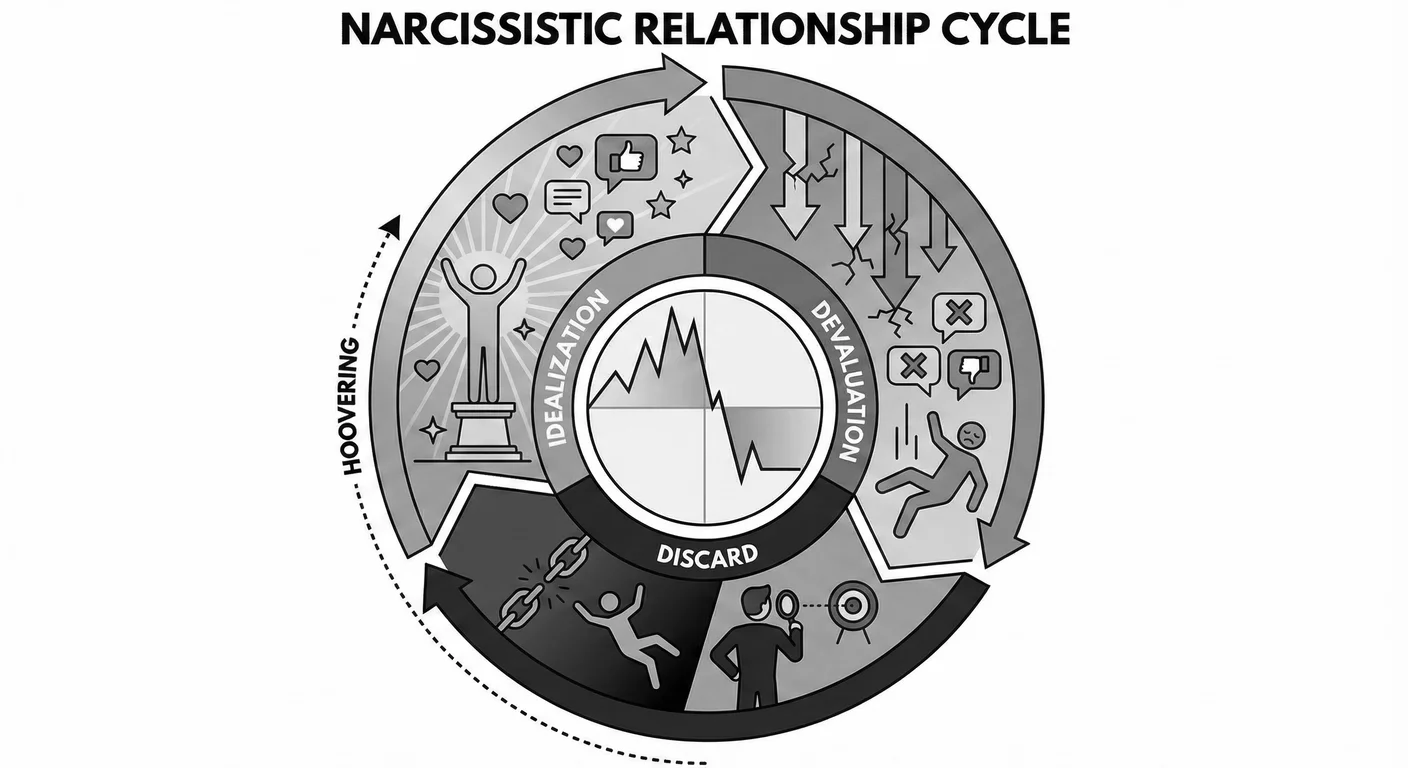
Devaluation Cycle
Idealisation $\rightarrow$ Devaluation $\rightarrow$ Discard. Neurobiological tolerance: you provide diminishing reward. This is not about you becoming less—their system requires novelty.
What you observe:
[topsep=4pt,itemsep=2pt]
-
Early phase: intense attention, idealization, “you’re different from everyone else”
-
Middle phase: criticism creeping in, comparisons to others, withdrawal of warmth
-
Late phase: contempt, dismissiveness, active search for replacement
-
The cycle repeats with each new relationship—you can watch it happen to your successor
What fails: Trying harder. Being more accommodating. Changing yourself to meet shifting criteria. The devaluation is not caused by your behaviour—it is caused by their neurobiological habituation to you as supply source.
What works:
[topsep=4pt,itemsep=2pt]
-
Recognise the pattern: You are in a cycle, not a unique failure.
-
Stop performing: Trying harder accelerates devaluation.
-
Leave first: Once devaluation is established, discard follows. Leave on your terms.
-
External validation: Friends, therapist, support groups.
Behavioural Rigidity
The same patterns repeat endlessly—with every partner, every job, every conflict. This is not stubbornness. The basal ganglia have encoded narcissistic defences as procedural memory, as automatic as walking.
What you observe:
[topsep=4pt,itemsep=2pt]
-
Same manipulative patterns with every new partner
-
Same self-aggrandising stories on autopilot
-
Cannot learn from relationship failures—repeats identical mistakes
-
Grandiose behaviours seem compulsive rather than chosen
What this means: These patterns run below conscious thought. They are not choosing to manipulate—the manipulation has become habit, like riding a bicycle. Insight alone rarely produces change: you cannot think your way out of a habit encoded below the level of thought.
What works:
[topsep=4pt,itemsep=2pt]
-
Stop expecting learning: The OFC’s reversal learning function is impaired. Feedback does not update behaviour.
-
Pattern interruption: Physically leave or change topics when the loop begins. You cannot reason with procedural memory.
-
Protect yourself from the loop: Recognise you are a new actor in an old script. The pattern is not about you.
-
Accept the limit: Change requires intensive, specialised therapy they probably will not pursue (Chapter ).
Neural Neutralisation Guide
Quick-reference: brain system $\rightarrow$ pattern $\rightarrow$ intervention. (Printable versions in Appendix .)
Neural Neutralisation Guide: Brain structures, patterns, and interventions
Structure & Pattern & Cause & Intervention
Structure & Pattern & Cause & Intervention
Brainstem and Early Processing
[2pt] Life-Keeper (Medulla) & Boundary diffusion & Cannot sense self-other boundary & Physical barriers: Locks, separate rooms, leave [3pt] Face-Reader (Spinal Trigeminal) & Facial hypervigilance & Hyperscans faces as threats & Blank Screen: Neutral face, relax muscles [3pt] Sentry (Locus Coeruleus) & Chronic alarm & Hyperactive norepinephrine & Calm Anchor: Low, slow voice; reduce stimulation
Midbrain and Attention
[2pt] Visual Scouts (Superior Colliculi) & Narcissistic capture & Reflexive orienting to self-stimuli & Pivot: Move side-to-side during rage [3pt] Sound Scouts (Inferior Colliculi) & Talks over you & Enhanced activation to own voice & Interrupt: Set time limits; boring topics
Thalamus and Filtering
[2pt] Gatehouse (Thalamus) & Hears what they want & Filters out non-self data & BIFF: Brief, Informative, Friendly, Firm
Basal Ganglia and Habits
[2pt] Habit Former (Dorsal Striatum) & Rigid loops & Defences become hard-coded habits & Pattern Interrupt: Leave or change topic [3pt] Reward Hub (Nucleus Accumbens) & Supply addiction & Dopamine dependency & Supply Starvation: Grey Rock or No Contact
Limbic System and Emotion
[2pt] Alarm Bell (Amygdala) & Narcissistic rage & Hijacks before PFC inhibits & Go-Bag Protocol: Pre-planned exit [3pt] Archivist (Hippocampus) & Gaslighting & Stress shrinks; confabulation fills gaps & Null Protocol: Don’t argue; keep records [3pt] Thermostat (Hypothalamus) & Possessiveness & Bonding rewards conquest & Protect attachment: Possessiveness $\neq$ love
Insula and Cingulate
[2pt] Translator (Anterior Insula) & Empathy void & Reduced grey matter & WIIFM: Frame as benefit to them [3pt] Sentinel (ACC) & Criticism hypersensitivity & Social friction = physical pain & Compliment Sandwich: Praise-Correction-Praise
Prefrontal Cortex
[2pt] Royal Portrait Gallery (vmPFC) & Grandiosity & Locked to self-reference & Radical Acceptance: They won’t see your view [3pt] Chief of Staff (DLPFC) & Word salad & Erratic when ego threatened & Time-Box: Limits; name pattern; exit [3pt] Treasurer (OFC) & Cannot update & Reduced reversal learning & Consequences: Boundaries must have teeth
Reading the Room
Real-time recognition: verbal cues, nonverbal signals, and your body’s early warning system.
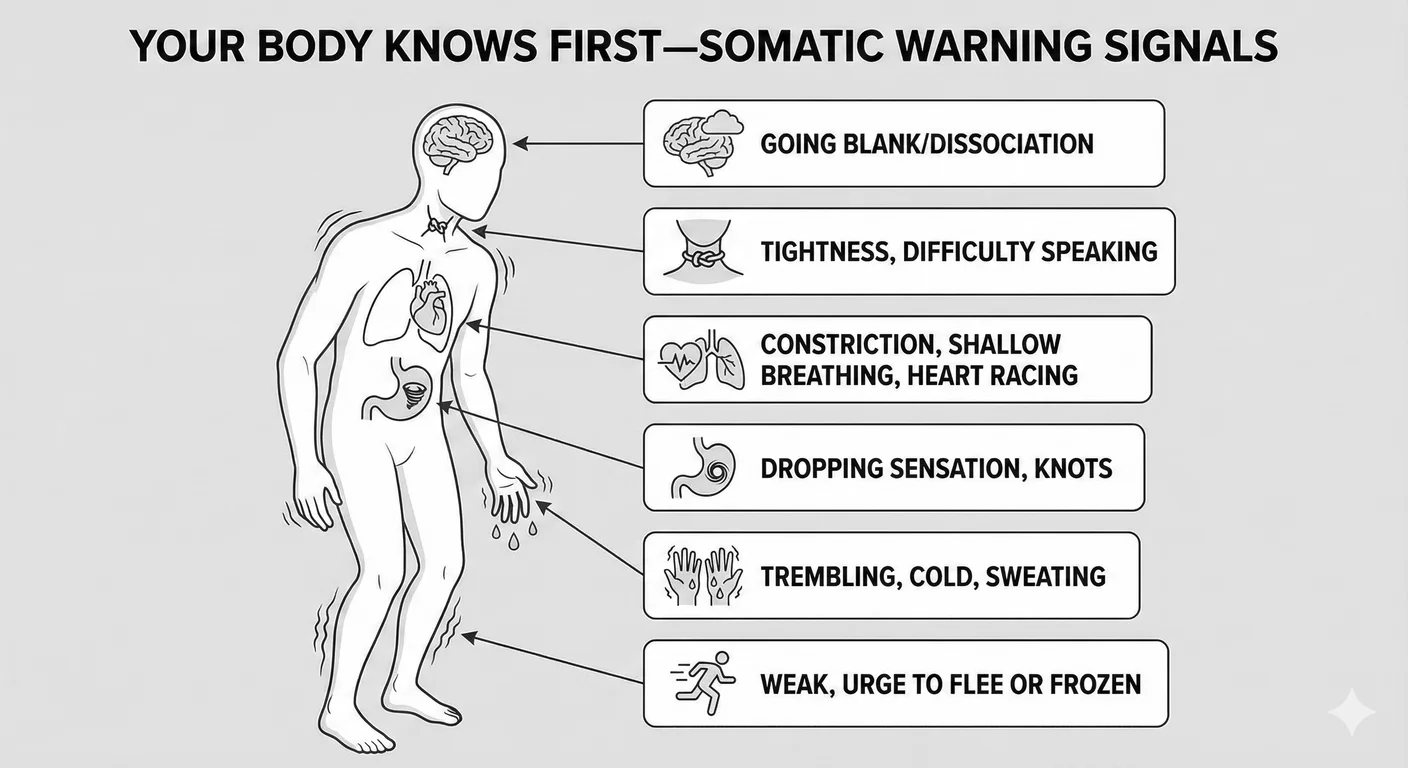
Body as Early Warning
Your body detects threat before your mind does. 1001 These signals are intelligence, not anxiety.
Somatic early warning signals
Body Signal | What It Indicates | Response | | — | — | — | Stomach dropping/tightening | Threat detection; something wrong even if unnamed | Trust the signal; increase vigilance | Chest constriction; shallow breath | Sympathetic activation; fight-or-flight engaging | Slow breathing; prepare exit | Freeze response (going blank) | Dorsal vagal shutdown; overwhelm | Freeze = data; you are in danger | Fawn response (urge to placate) | Survival adaptation; neutralising threat | Notice urge; don’t act automatically | Dissociation (“outside” self) | Protective disconnection from overwhelm | Ground yourself; consider leaving | Walking-on-eggshells | Chronic hypervigilance | Valid data: this person is unsafe |
Chronic Hypervigilance
The narcissist’s nervous system never stands down. The locus coeruleus—the brainstem’s alarm coordinator—maintains perpetual fight-or-flight readiness, scanning for threats to the self-image rather than real dangers.
What you observe:
[topsep=4pt,itemsep=2pt]
-
Cannot relax even in safe environments
-
Startles at criticism but ignores actual danger
-
Sleep disturbance—never fully restorative
-
Hears their name across a crowded room but misses your distress beside them
-
Exhaustion beneath the bravado
What this means: Their hypervigilance is physiological, not chosen. The body never receives the “all clear” signal. They are genuinely tired in a way rest cannot fix.
What works:
[topsep=4pt,itemsep=2pt]
-
Do not try to calm them: Their arousal is neurological, not situational.
-
Reduce your own reactivity: Their vigilance feeds on environmental stimulation.
-
Predictable patterns: Routine reduces perceived threat—though it will not eliminate it.
-
Protect yourself from their vigilance: Their hyperawareness of ego threats means you will be monitored. Assume surveillance.
Boundary Violations
Narcissistic individuals struggle to perceive where they end and others begin. This is not merely entitlement—it reflects genuine neural confusion about self-other boundaries, rooted in parietal cortex dysfunction and impaired interoception.
What you observe:
[topsep=4pt,itemsep=2pt]
-
Your possessions are “ours”
-
Your time is available on demand
-
Your emotions are about them
-
Physical space invaded without awareness
-
Reading your mail, phone, journal
-
Decisions made for you
-
Your achievements are their achievements
What this means: The parietal cortex constructs maps of self in space. In NPD, these maps are distorted—the boundary of “self” extends to encompass people and possessions perceived as extensions. They genuinely do not experience taking your things as crossing a line.
What works:
[topsep=4pt,itemsep=2pt]
-
Physical barriers: Locks, passwords, separate accounts. Verbal boundaries are insufficient when the boundary itself is not perceived.
-
Consequences, not conversations: They cannot learn boundaries through discussion. Boundaries must have tangible consequences for violation.
-
Reduce enmeshment: Separate what can be separated—finances, social circles, living space if possible.
-
Name the pattern to yourself: “This is boundary violation” helps you resist normalisation.
Splitting
All-good or all-bad categories. Cannot hold ambivalent views.
Signs: “You’re the only one who understands me” followed eventually by “You’re just like [devalued person].” Sudden devaluation of people previously praised. Intensity mismatch—deep declarations disproportionate to relationship duration. Contempt microexpressions when mentioning the “bad” category.
Your signals: Feeling “chosen.” Unease at how viciously they describe others. Pressure to align with their categories. Dread you’ll join the “bad” category.
Key insight: If everyone before you was terrible, you are not the exception—you are next. The more intense the early idealisation, the more severe the eventual devaluation. 1048
Response:
[topsep=4pt,itemsep=2pt]
-
Null Protocol: Their categorisations are assertions without evidence. You do not need to accept the “good” label or fear the “bad” one—both are projections, not assessments.
-
Refuse the role: Do not compete to remain in the good category. The competition itself is the trap.
-
Maintain your own perception: The people they vilify are probably more nuanced than described. Trust your direct experience over their framing.
-
Recognise the forecast: How they describe others predicts how they will eventually describe you.
Narcissistic Injury and Impending Rage
Narcissistic Injury Narcissistic Injury A perceived threat to a narcissist's self-image that triggers disproportionate emotional reactions including rage, shame, humiliation, or withdrawal. —the wound to grandiose self-image—precedes rage.
Signs: Sudden topic change from anything implying criticism. Cold, clipped responses replacing warmth. “After everything I’ve done for you…” Escalating rhetorical questions. Facial flash of rage quickly masked. Physical stiffening. Voice pitch lowering. Stillness—a predatory pause.
Your signals: Walking-on-eggshells intensifying. Impulse to apologise without knowing what for. Urge to make yourself smaller.
Intervention window: Narrow. Use Calm Anchor or Go-Bag Protocol. Once rage activates, the window closes.
Gaslighting in Progress
Gaslighting Gaslighting A manipulation tactic where the abuser systematically makes victims question their own reality, memory, and perceptions through denial, misdirection, and contradiction. works best when unrecognised.
Signs: “That never happened.” “You’re remembering it wrong.” “You’re too sensitive.” “Everyone agrees with me.” Calm, measured delivery while you feel destabilised. Performative confusion. Eye-rolling or sighing at your “confusion.”
Your signals: Confusion disproportionate to the conversation’s complexity. Doubting your own memory. Urge to check records. Physical anxiety despite “calm” discussion. Feeling “crazy.”
Key insight: If you feel confused and destabilised while they appear calm and certain, this asymmetry is diagnostic. Healthy disagreement does not produce this pattern.
Response:
[topsep=4pt,itemsep=2pt]
-
Null Protocol: Their version is an assertion without evidence. You do not need to prove your memory correct—you need only recognise that their claim carries no more weight than yours. Treat it as noise, not data.
-
Do not argue: Argument is the goal. “I remember it differently” once, then disengage.
-
Trust your records: Journals, texts, emails. Your documentation is your anchor.
-
Name it internally: “This is gaslighting” breaks its power. You do not need to name it aloud.
Love Bombing
Love Bombing Love Bombing An overwhelming display of attention, affection, and adoration early in a relationship designed to create rapid emotional dependency and attachment. —overwhelming early courtship—differs from genuine enthusiasm.
Signs: “Soulmate” language within days. “I’ve never felt this way before.” Pressure to commit quickly. Future-planning before present-knowing. Constant contact. Mirroring your interests with suspicious precision. Gift-giving that feels obligating. Showing up uninvited.
Your signals: Overwhelm disguised as flattery. Sense it’s “too good to be true.” Guilt when you want space. Friends expressing concern about the pace.
The test: Genuine connection respects your pace. If slower progression triggers sulking or anger, you have your answer.
Future Faking
Promising a future that will never materialise—keeps victims invested while delivering nothing.
Signs: Grandiose plans with no concrete steps. Promises contingent on your compliance: “Once you [change], then I’ll…” Recycled promises never fulfilled. Vague, shifting timelines. Deflection when you ask for specifics. Enthusiasm for fantasy, disinterest in execution.
Your signals: Excitement mixed with doubt. Realising you’ve heard this before. Making excuses for why it hasn’t happened.
Reality test: Track promises against delivery. A pattern of unfulfilled promises is the only data that matters.
Devaluation in Progress
The shift from idealisation to devaluation begins subtly.
Signs: Put-downs disguised as jokes. Unfavourable comparisons to exes or others. “You used to be [positive trait].” Criticisms framed as “helping.” Eye-rolling, sighing. Looking at phone while you speak. Physical withdrawal. Public corrections.
Your signals: Shrinking sense of self. Anxiety about “getting it right.” Trying harder while receiving less. Missing who you used to be.
Key insight: Devaluation reflects their neurobiological tolerance to you as supply, not your diminished worth. Their reward circuitry habituated—you did not become less. 240
Response:
[topsep=4pt,itemsep=2pt]
-
Null Protocol: Their criticisms are assertions without evidence. “You used to be better” is not data about your decline—it is data about their habituation. Dismiss it as noise.
-
Stop trying harder: Increased effort accelerates devaluation. You cannot earn your way back to the idealisation phase.
-
Reconnect with yourself: Who were you before this relationship? What did you value? The shrinking you notice is real—begin reclaiming space.
-
Plan your exit: Devaluation predicts discard. Leave on your terms rather than waiting to be discarded.
Hoovering
The attempt to suck a victim back after discard or escape.
Signs: Sudden contact after silence. “I’ve changed” / “I’ve been in therapy.” Emergencies requiring your specific help. Nostalgia appeals. Perfect-sounding apologies (scripted, not felt). Appearing at your locations “coincidentally.” Social media engagement after silence. Using mutual contacts.
Your signals: Relief mixed with dread. Old hope reactivating. Doubt about leaving. Physical longing. Guilt, though you did nothing wrong.
Neurobiological reality: The pull is not evidence you should return. It is the opioid system responding to potential reunion after withdrawal—addiction neurobiology, not love. 781
Triangulation
Introducing a third party to create insecurity or competition.
Signs: “[Person] thinks you…” “My ex never had a problem with this.” Manufacturing jealousy through detailed descriptions of others. Flirtatious behaviour while you watch. Comparing you unfavourably to third parties.
Your signals: Insecurity about your position. Competitive feelings towards uninvolved people. Urge to “prove” yourself. Jealousy that feels induced rather than organic.
The purpose: Generating supply through your emotional reaction. Recognition breaks its power.
Response: Refuse to compete—do not work harder, prove yourself, or attack the third party. A neutral “That’s interesting” denies the reaction they seek. Name the pattern to yourself. Verify claims independently. Maintain direct relationships with those being used to triangulate.
Flying Monkeys
Individuals who act on behalf of the narcissist—knowingly or unknowingly—to gather information, relay messages, and pressure targets. 338
Types: Unwitting allies genuinely believe the narcissist’s version. Fearful compliers participate to avoid becoming targets. Co-narcissists enjoy the power. Information gatherers seem sympathetic while reporting back.
Signs: They relay messages when you’ve established no contact. They press you to “see both sides.” They defend the narcissist using the narcissist’s framing. After talking to them, the narcissist has new information about you.
Response: Information diet—share nothing with anyone connected to the narcissist. With unwitting allies, state your reality once; do not over-explain. Set topic boundaries: “I’m not willing to discuss [narcissist].” Limit or end relationships with those who function as extensions of the narcissist. Do not attack the narcissist to them—it will be reported.
Relationship Stage Tactics
The same narcissistic neurology manifests differently depending on the relationship stage. What you can do—and what you should prioritise—shifts as entanglement deepens.
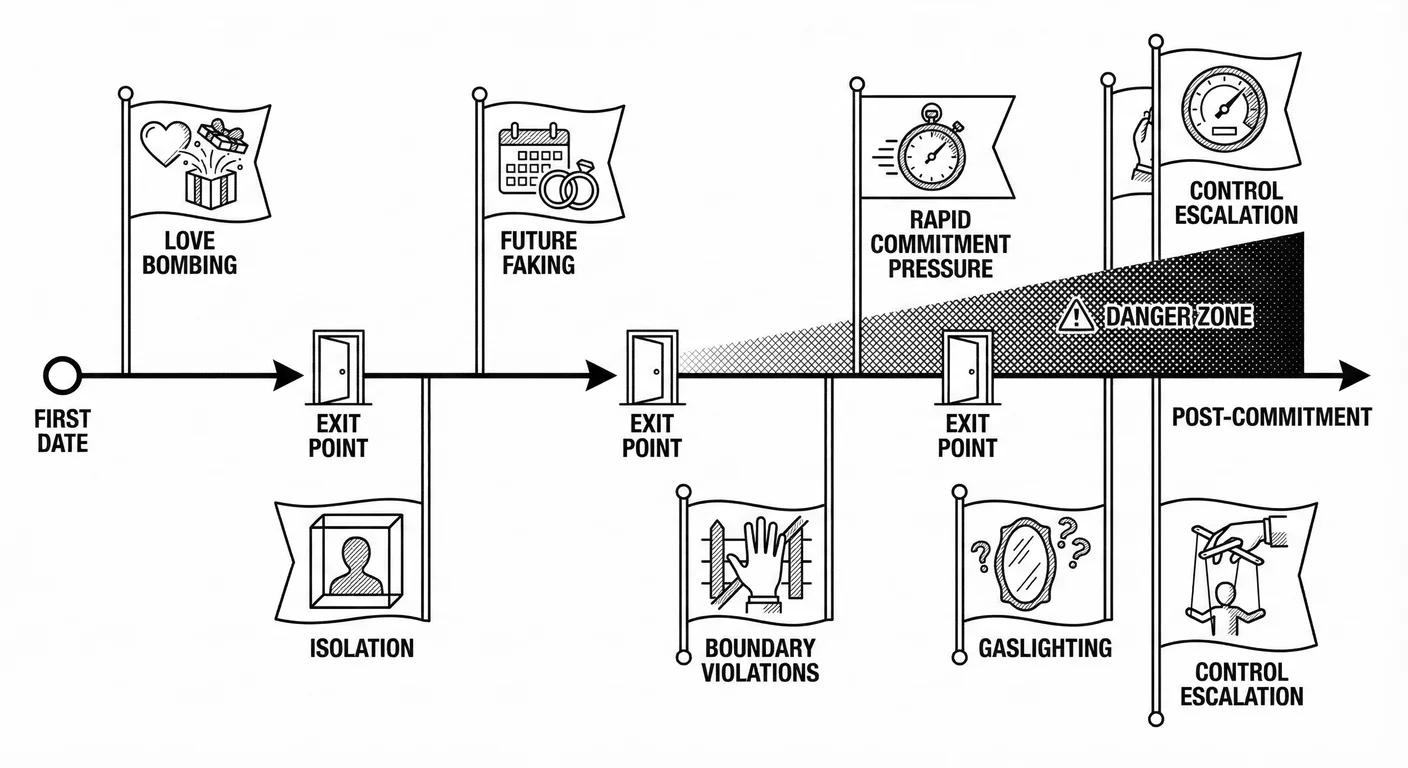
Early Dating: Warning Signs
Narcissists make excellent first impressions—the charm typically holds for about seven interactions. 61 Recognise signs before significant entanglement.
Yellow flags (first date): Conversational imbalance—they talk, you listen. Status display and name-dropping. 426 Rudeness to waitstaff (how they treat people who cannot benefit them is their baseline). Ex-partner vilification with no self-accountability. Intensity mismatch—“I feel like I’ve known you forever.” Boundary testing.
Red flags (first weeks): Love bombing—excessive attention designed to accelerate intimacy. 1195 Future faking—detailed plans before you know each other. Isolation pressure. Rapid commitment pressure. Gaslighting others (preview of your future). Contempt masked as humour.
Key diagnostic: Watch how they treat others—service workers, exes, subordinates. Charm towards you plus contempt towards others reveals strategic warmth, not constitutional empathy. The ex they call “crazy” was once idealised too.
Exit: Early dating is lowest-stakes. “I don’t think we’re a match” requires no explanation. Trust your nervous system—if your body signals danger while your mind makes excuses, your neuroception is detecting what cognition hasn’t processed. 1001
Post-Commitment Escalation
Controlling or abusive behaviour commonly escalates after commitment milestones—moving in, engagement, marriage, pregnancy. The timing is strategic.
Why: Your exit costs have increased; the mask is exhausting to maintain; winning you shifts to owning you; early boundary violations were probes.
Signs: Criticism replacing admiration. Increased control over finances, social connections, decisions. Rage at boundaries previously respected. “You’ve changed” accusations (describing their changed behaviour). Isolation intensification. First instances of name-calling, threats, or intimidation.
Understanding: They did not change; they revealed. The loving partner was performance; this is closer to baseline. It is unlikely to improve without intensive intervention they probably won’t seek.
Response: Document from the start—dates, incidents, witnesses. Consult professionals privately (therapist, lawyer, DV advocate) without informing your partner. Assess safety first; if there’s any history of intimidation or threats, prioritise safety planning over relationship repair.
The next chapter continues with family dynamics, crisis situations, and what to do when you are accused of being the narcissist.
Continue reading "Field Guide: Recognition"
Get the complete book with all 21 chapters, plus PDF and EPUB downloads for offline reading.
One-time purchase. No subscription required.
Enjoying the book?
Get the complete book with all 21 chapters in PDF and EPUB formats.
Buy Now – $12.99