You know you need to leave. Or you cannot leave—not yet, not entirely—and you need to survive. Perhaps you share children with someone who will weaponise every exchange. Perhaps the narcissist is your parent, your boss, your sibling whose absence would fracture the family. Perhaps you have only just recognised what you are dealing with, and the path forward remains unclear.
This chapter is for all of these situations. For help recognising narcissistic patterns across contexts—intimate relationships, workplace, friendships, neighbours, professional relationships—see Chapter 1’s Field Guide. For recovery and healing after you have reached safety, see Chapter .
Boundary Setting
Setting Boundaries Boundaries Personal limits that define what behaviour you will and won't accept from others, essential for protecting yourself from narcissistic abuse. with narcissists is extraordinarily difficult—and nothing like boundary-setting in normal relationships. Narcissists experience Boundaries Boundaries Personal limits that define what behaviour you will and won't accept from others, essential for protecting yourself from narcissistic abuse. as Narcissistic Injury Narcissistic Injury A perceived threat to a narcissist's self-image that triggers disproportionate emotional reactions including rage, shame, humiliation, or withdrawal. , a fundamental assault on their entitlement to unlimited access and control. They will test and attempt to demolish any boundary that limits their validation or control.
Understanding Narcissistic Boundary Violations
Narcissists do not simply cross boundaries; they do not recognise others’ right to have boundaries. In the narcissistic worldview, other people exist as extensions of themselves or sources of validation, not separate beings with their own rights and needs. This fundamental inability to recognise otherness makes boundary violations inevitable and systematic. Stop expecting narcissists to respect boundaries through explanation or appeal—they cannot respect what they cannot perceive 830 .
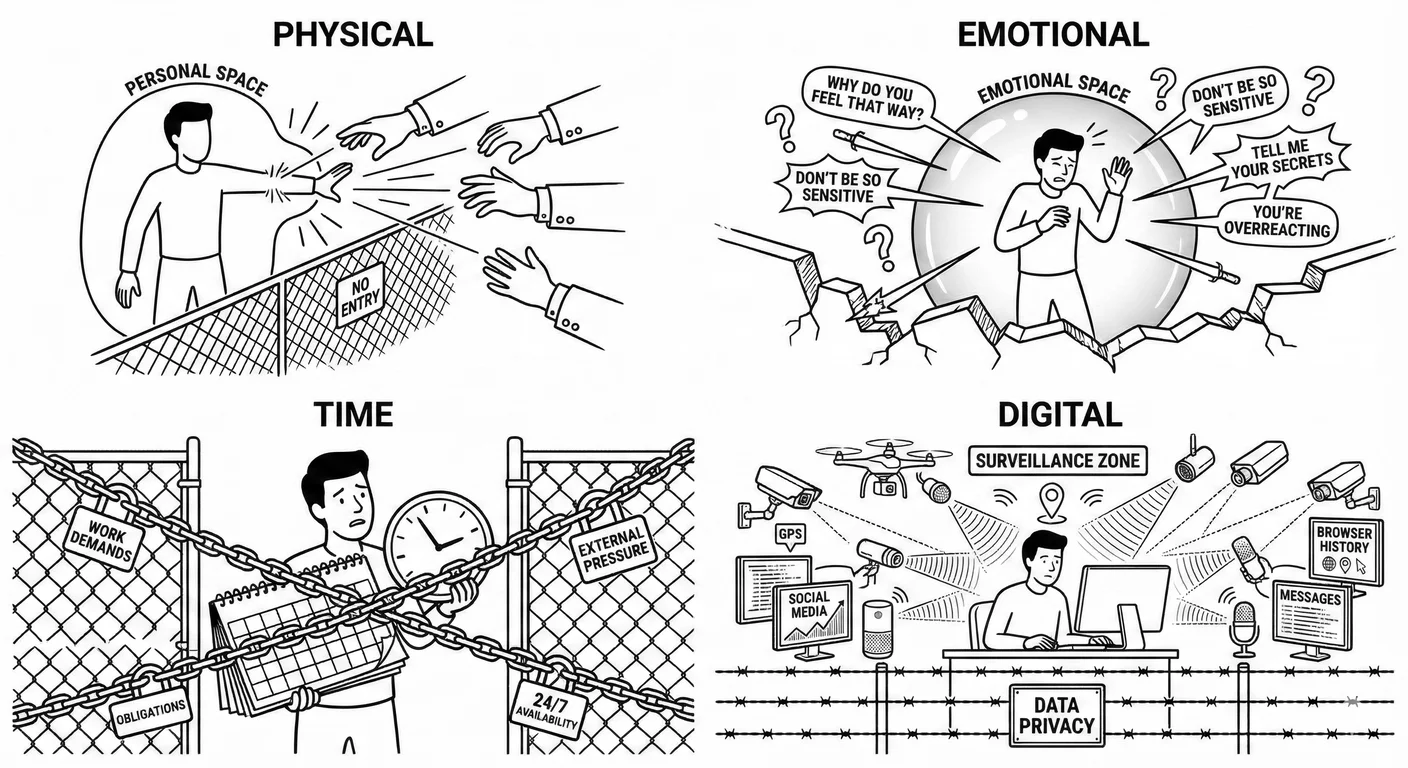
Physical boundary violations might seem obvious but often escalate so gradually that victims do not recognise the progression. It might start with standing too close, “playful” touches that feel uncomfortable, or entering your space without permission. The narcissist might go through your belongings, read your private communications, or show up uninvited at your workplace or home. When confronted, they dismiss concerns: “We’re family/married/together, we shouldn’t have secrets,” or “You’re being paranoid.” The violation is not just physical but psychological: the message that you do not have the right to private space 364 .
Emotional boundaries prove even harder to protect. Narcissists demand unlimited access to your emotional state, becoming angry when you need solitude or emotional privacy. They might insist on knowing all your thoughts and feelings, probe relentlessly when you are upset, or demand emotional availability regardless of your state. One survivor described: “He would follow me from room to room when I needed space to calm down, saying we needed to ‘resolve this now.’ My need for emotional regulation time was seen as punishment or manipulation. I wasn’t allowed to have feelings he didn’t authorise or witness.”
Time boundaries trigger particular Narcissistic Rage Narcissistic Rage An explosive or cold, calculated anger response triggered when a narcissist experiences injury to their self-image, far exceeding what the situation warrants. . Your time belongs to them; any use of it for others or yourself is theft. They might call or text constantly, expecting immediate responses. They create crises that demand immediate attention. They schedule things without consulting you then rage when you have conflicts. They see work and family as competition for your attention. The message is clear: your time is not yours to allocate 1142 .
Strategic Boundary Implementation
Setting boundaries with narcissists differs fundamentally from boundary-setting in healthy relationships. In healthy contexts, you explain your needs, the other person adjusts their behaviour, and mutual respect is maintained. With narcissists, explanation becomes ammunition, and boundary-setting becomes warfare. The strategy must shift from mutual understanding to self-protection.
State boundaries clearly without justification. “I won’t discuss this further” is complete; “I won’t discuss this further because you get angry and I feel unsafe” provides information they will weaponise. Every reason offered becomes a target for manipulation: “So you think I’m dangerous? You’re the abusive one, always accusing me.” Boundaries without explanation give them nothing to grip. They will demand reasons, and refusing to provide them is itself boundary practice 255 .
Expect boundary testing and plan responses in advance. The narcissist will probe every boundary for weakness. “But this is different.” “Just this once.” “If you really loved me.” “What about when you…” Having predetermined responses prevents in-the-moment capitulation: “My answer is the same as before.” “I’ve already addressed this.” “This conversation is over.” Repetition without elaboration exhausts their strategies.
Implement consequences without threats. Threats become challenges they feel compelled to overcome. Instead, simply implement consequences when boundaries are violated. If the boundary is “I will end the call if you raise your voice” and they raise their voice, end the call without warning. The consequence teaches more effectively than words. “You hung up on me!” “Yes. Call back when you can speak calmly.” Boundaries are real, not negotiable 1142 .
Document violations systematically. Patterns of boundary violation become evidence in legal proceedings and therapy discussions—and in your own reality-testing when gaslighting makes you doubt yourself. Date, time, what happened, what was said, witnesses if any. This documentation serves multiple functions: legal protection and therapeutic processing, as well as personal clarity.
grey rock method
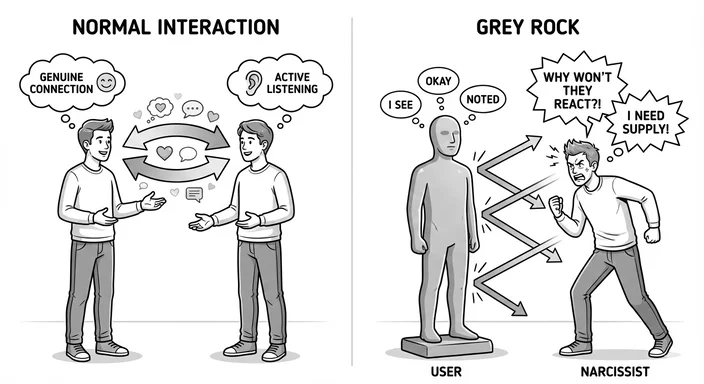
When complete separation from a narcissist proves impossible—through shared children, workplace proximity, family obligations, or other unavoidable ties—the Grey Rock method offers a survival strategy. The goal is to become so uninteresting that the narcissist loses interest and seeks supply elsewhere.
Understanding the Psychology
Narcissists require emotional reaction to feed their sense of importance. Your tears and rage provide the validation they need. Grey Rock starves this need by offering nothing but bland neutrality. Think of a stone on the beach: unmoved by waves, offering nothing interesting, provoking no response 914 .
The strategy works because narcissists are fundamentally bored by anything that does not reflect or feed their grandiosity. If you become boring, you become useless as a supply source. They will eventually redirect their attention to more responsive targets. This does not mean they will leave you alone entirely—hoovering attempts will occur when other sources dry up—but the intensity and frequency of engagement decreases.
Practical Implementation
Responses should be brief and emotionally neutral. “Yes.” “No.” “Okay.” “I’ll consider that.” “The children will be ready at 5.” Provide no emotional content, no personal information, no reaction to provocation.
This is harder than it sounds. They text: “You’ve destroyed this family.” Every cell in your body wants to defend yourself, to explain, to fight back. Instead, you type: “I’ll have the kids ready at 5.” Send. Nothing more. They text again: “You’re pathetic. Your new partner is ugly.” You do not respond. Your hands may shake. Your heart may pound. But the phone stays silent. You have given them nothing to grip.
Eliminate topics that provide supply. Do not share successes they might envy or failures they might exploit. Do not discuss your emotional state, your relationships, your hopes or fears. Share only the minimum information required for necessary logistics. “How are you?” becomes “Fine. About the schedule…”
Maintain neutral body language. The narcissist reads microexpressions expertly, scanning for any reaction they can exploit. Practice flat affect—not hostile, not warm, simply neutral. The same expression whether they are raging or love bombing. This requires significant practice, often with therapeutic support, but the poker face becomes essential armour.
Grey Rock has limitations. It works best for peripheral relationships—neighbours, colleagues, extended family. In intimate relationships or with a narcissistic parent, the lack of response may escalate abuse as they try harder to provoke reaction. When starved of supply, some narcissists intensify rather than withdraw. In these cases, Grey Rock becomes a transitional strategy while planning extraction rather than a permanent solution 42 .
The BIFF Method
For written communication, particularly in co-parenting or professional contexts, the BIFF Method BIFF Method A communication technique for responding to hostile or high-conflict messages: Brief, Informative, Friendly, and Firm. provides structure: Brief, Informative, Friendly, Firm.
Brief: Keep responses short. Long responses provide ammunition and invite further engagement. Two to three sentences maximum for most situations.
Informative: Stick to facts and necessary information. “The children’s doctor appointment is Tuesday at 3 PM” rather than “I wish you would be more involved in their healthcare instead of leaving everything to me.”
Friendly: Maintain a professional, cordial tone. Not warm, not hostile. “Thank you for letting me know” costs nothing and deprives them of conflict fuel.
Firm: End the conversation clearly. “I’ll handle it from here” or “No response needed” signals that the exchange is complete. Do not leave openings for continued engagement 349 .
BIFF responses require practice. The instinct to defend yourself, to explain or correct, is powerful, especially when being falsely accused or manipulated. Having templates prepared in advance helps: “Thank you for sharing your perspective. I’ll handle the arrangements as discussed.” The response addresses nothing they said while ending the exchange.
No Contact Decisions
For many survivors, complete no contact is the only path to healing. The narcissist’s presence—even through text messages or social media—reactivates trauma responses. It prevents the nervous system from resetting and maintains the psychological bond that keeps victims trapped.
When No Contact Becomes Necessary
Physical safety concerns eliminate all other considerations. If you fear for your physical safety, professional safety planning and complete separation become necessary. Contact domestic violence resources for guidance specific to your situation.
Continued psychological harm despite boundaries indicates the relationship cannot be managed. If every interaction leaves you dysregulated, if you spend hours or days recovering from brief exchanges, if the narcissist circumvents every boundary, the relationship itself is the problem.
Pattern recognition after multiple attempts shows that Grey Rock and boundaries have failed. If you have tried every strategy and the abuse continues, the only remaining option is removing yourself from the relationship entirely.
Personal cost-benefit analysis reveals net harm. Some relationships might be theoretically manageable but require more energy than they provide. The extended family member who triggers weeks of depression for each holiday gathering, the friend who leaves you feeling depleted after every interaction—when the cost consistently exceeds any benefit, no contact becomes self-care 830 .
Implementation Strategies
Sudden versus gradual no contact depends on circumstances. Sudden cutoff works when safety is not a concern and you can tolerate the Extinction Burst Extinction Burst A temporary intensification of unwanted behaviour when that behaviour stops being reinforced—expect escalation when you stop giving a narcissist what they want. —the escalated attempts to re-establish contact that typically follow abrupt ending. Gradual fading works when you need to prepare practically or emotionally, though it prolongs the difficult transition period.
Whether to inform the narcissist requires strategic consideration. Sometimes a clear statement helps: “I’ve decided to end contact. Please do not reach out.” A clear statement provides closure and creates documentation if they violate the boundary. Other times, silence works better—no explanation provides nothing to argue with, nothing to weaponise. Consider which approach suits your situation and the specific narcissist.
Block comprehensively. Phone, email, social media, messaging apps—they will exploit any channel left open. Consider email filters that automatically archive (but do not delete, in case needed for legal purposes) rather than simply blocking, so you have documentation without constant exposure.
Prepare for the extinction burst. When narcissistic supply is cut off, most narcissists escalate dramatically before giving up. This is the hardest part. The first week, they love bomb: “I’ve changed. I finally understand. Please, just talk to me.” When that fails, rage: “You’ll regret this. I’ll make sure everyone knows what you really are.” Then guilt: “Your mother is crying every day. How can you do this to your family?” Then the flying monkeys arrive—mutual friends, relatives, colleagues recruited to pressure you: “They seem really sorry. Maybe you should give them another chance.”
Every instinct screams to respond, to explain, to defend yourself. Do not. The extinction burst is a test. If you respond at the rage stage, they learn that rage works. If you respond to the guilt, they learn that guilt works. Any response teaches them which button to press harder next time.
Having support in place before initiating no contact helps weather this storm. The extinction burst typically peaks within the first few weeks and diminishes over months, though hoovering attempts may continue indefinitely at lower intensity 205 .
Address shared connections. Flying monkeys—people the narcissist recruits to pressure you—will likely appear. Have responses prepared: “I’ve made my decision and won’t discuss it further.” “Please don’t pass messages between us.” “This is between them and me.” Some people may need to be limited or removed from your life if they cannot respect your boundaries.
When No Contact Is Not Possible: Harm Reduction
Not everyone can go no contact. Co-parents share children. Adult children may have elderly narcissistic parents requiring care decisions. Employees depend on narcissistic bosses for their livelihood. Family businesses intertwine finances. Cultural or religious obligations create expectations that cannot be easily dismissed. For these situations, harm reduction—minimising damage while accepting that some exposure is unavoidable—becomes the realistic goal.
Accepting the Limitation
The first step is radical acceptance: this person will not change, and you cannot fix them.
This is harder than it sounds. Part of you still believes—despite everything—that if you could just find the right words, demonstrate enough patience, love them well enough, something would finally click. They would see what they have done. They would become the parent, partner, or friend you needed them to be. This fantasy keeps you trapped in cycles of hope and disappointment, trying the same approaches with minor variations, waiting for a transformation that the evidence of years suggests will never come.
Releasing this fantasy is grief work. You are mourning the relationship you wanted but will never have. You are mourning the parent who should have protected you, the partner who should have cherished you, the sibling who should have been your ally. That person does not exist. Accepting this is a death—and grief is the appropriate response.
Acceptance does not mean approval. You can accept that your narcissistic mother will always criticise while refusing to internalise that criticism. You can accept that your co-parent will weaponise the children while protecting them as much as possible. Acceptance means directing energy towards what you can control rather than exhausting yourself trying to change what you cannot.
Structured Contact Protocols
When contact is unavoidable, structure provides protection:
Limit frequency and duration. See the narcissistic family member at holidays only, not weekly dinners. Keep phone calls to fifteen minutes with a pre-planned exit: “I need to go—someone’s at the door.” Shorter, less frequent contact means less opportunity for damage.
Choose public settings. Narcissists moderate behaviour when witnesses are present. Meet in restaurants, not their home. Attend family gatherings where others buffer direct interaction. Public settings provide natural time limits and reduce the likelihood of explosive behaviour.
Bring allies. A supportive partner or friend provides reality-testing in the moment and emotional support afterward. Brief them beforehand: “If I squeeze your hand, help me change the subject.” Their presence alone often moderates narcissistic behaviour.
Control the exit. Drive yourself. Have your own transport and accommodation. Never be dependent on the narcissist for leaving. “I can’t stay—I have an early flight” is unchallengeable when you actually have one.
Psychological Protection During Contact
The “Researcher” stance. Observe the narcissist as if studying a specimen. “Interesting—there’s the contemptuous microexpression I’ve read about.” This cognitive distance reduces emotional reactivity and transforms painful interactions into data collection.
Pre-planned responses. Have phrases ready: “That’s one way to see it.” “I’ll think about that.” “Mm-hmm.” Scripted responses prevent being caught off-guard and reduce the cognitive load of real-time navigation.
Post-contact decompression. Schedule recovery time after unavoidable contact. Plan something nurturing: time with supportive friends, favourite activities, or simply solitude to process. Your nervous system needs time to down-regulate after narcissistic exposure.
Reality anchors. Keep evidence of your own perception—journal entries, texts from supportive friends, your therapist’s observations. When gaslighting distorts your reality, these anchors help you find solid ground again.
When Harm Reduction Fails
Harm reduction is not indefinite acceptance of abuse. It is a strategy for situations where no contact is genuinely impossible. Regularly reassess: Has anything changed that makes no contact possible now? Is the harm reduction actually reducing harm, or merely enabling continued abuse? Are you telling yourself no contact is impossible because it’s true, or because leaving feels too frightening?
Some survivors discover that what felt impossible—leaving the job, setting boundaries with parents, moving to another city—becomes possible once they build resources and support. Harm reduction can be a bridge to eventual freedom, not a permanent settlement. Keep the door open.
Co-Parenting Strategies
Co-parenting with a narcissist is brutally hard. Complete no contact is impossible; the children’s wellbeing requires some coordination; and the narcissist often uses the children as pawns for continued control and abuse.
Protecting Children from Narcissistic Damage
Children in narcissistic family systems face developmental risks explored in earlier chapters. The co-parent can mitigate some damage while accepting they cannot control what happens during the narcissist’s parenting time.
Be the stable parent. Provide consistency and emotional availability—the unconditional regard that the narcissistic parent cannot offer. Children need one reliable attachment figure to develop secure attachment; you can be that figure even if the other parent is harmful. Research shows that one consistently supportive caregiver can buffer children against significant adversity 813 .
Avoid triangulation. Do not use children as messengers or spies, nor recruit them as allies. Do not criticise the other parent to them, however justified. Children should not feel they must choose sides or manage adult relationships. “That’s between your father/mother and me” protects them from adult conflicts.
Validate without undermining. When children report concerning behaviour, validate their feelings without attacking the other parent. “That sounds like it was hard” acknowledges their experience. “Your father is a narcissist who doesn’t care about you” burdens them with adult knowledge they cannot process and may trigger loyalty conflicts that increase their distress.
Document concerning behaviour. Keep records of what children report and changes in behaviour after visits, along with any direct observations of problematic parenting. This documentation may become necessary if legal action is required, but keep it private from children 241 .
Parallel Parenting Framework
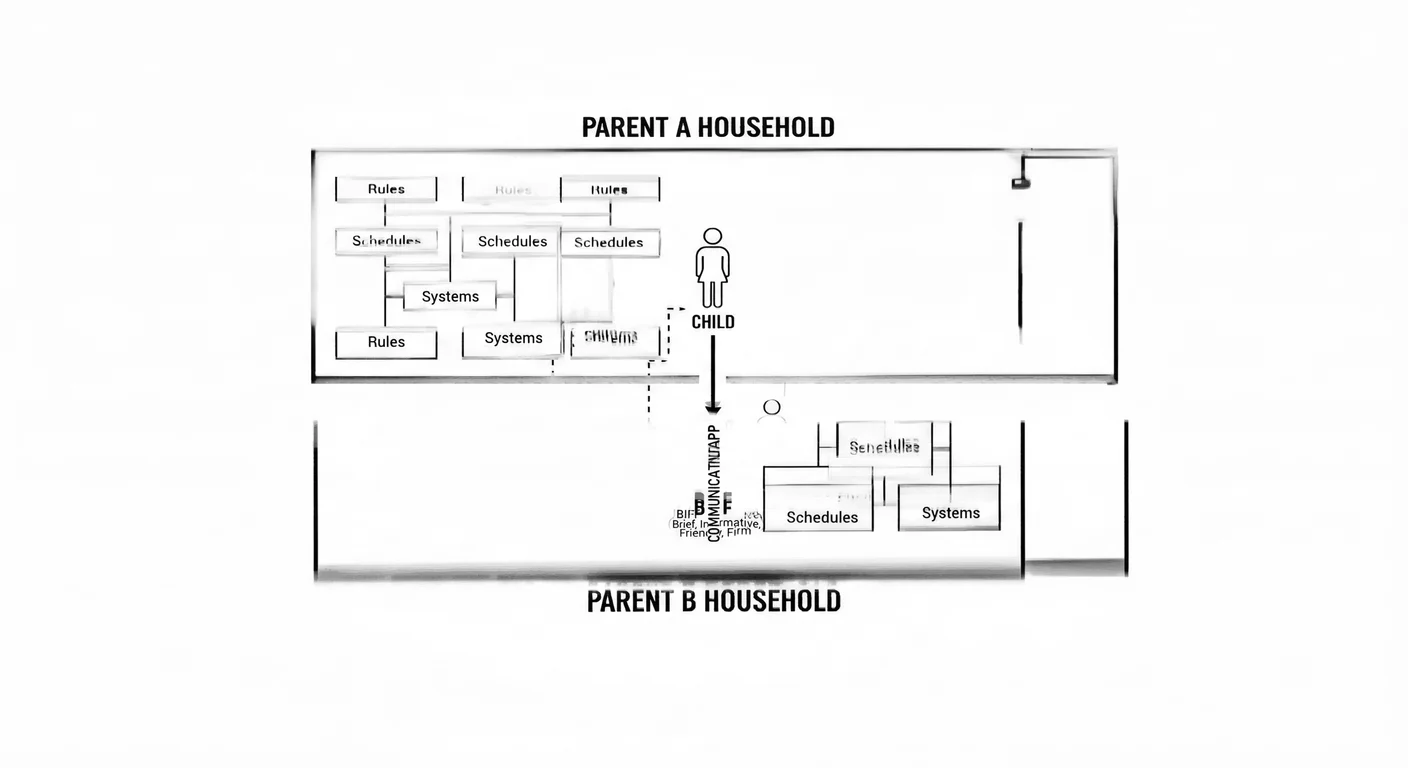
Traditional co-parenting assumes two parents who can communicate and prioritise children’s needs cooperatively. This model fails with narcissists, who use every communication as opportunity for conflict and control. Parallel Parenting Parallel Parenting A parenting arrangement for high-conflict situations where parents disengage from each other while maintaining separate relationships with their children. offers an alternative: each parent manages their own parenting time independently with minimal direct interaction.
Parallel parenting means separate household rules and expectations. Children adapt to different contexts—they behave differently at school than at home, at grandparents’ than with friends. They can adapt to different parenting styles as long as both environments are safe. Attempting to coordinate every detail with a narcissist provides endless opportunities for conflict that harm children more than minor inconsistencies would.
Communication through structured channels reduces conflict. Parenting apps like OurFamilyWizard create documented records while reducing direct interaction. Email provides documentation and time to compose measured responses. Avoid phone calls and in-person conversations except for genuine emergencies 349 .
Use third parties when possible. Exchanging children at neutral locations or through school (one parent drops off, other picks up) eliminates conflict-prone direct handoffs. If direct exchange is necessary, keep it brief and public: “Here’s her bag. See you Sunday.” Any discussion happens later through structured channels.
Support Systems
Recovery from narcissistic abuse requires support systems that grasp these specific dynamics. Unlike support for other difficulties, narcissistic abuse recovery demands understanding of trauma bonding, gaslighting, and the complex grief of leaving someone who harmed you. Survivors whose abusers isolated them and shattered their trust struggle to build these support systems—yet connecting with others who understand proves vital.
Professional Support Networks
Finding therapists who truly understand narcissistic abuse challenges survivors but remains essential. Many therapists, even experienced ones, lack training in personality disorders and may inadvertently retraumatise survivors through couples counselling recommendations, suggestions to understand the narcissist’s perspective, or dismissal of psychological abuse. Screen potential therapists carefully and leave therapeutic relationships that do not help.
When screening potential therapists, specific questions reveal their understanding: Do you have experience treating survivors of narcissistic abuse? What is your approach to personality disorders? How do you view couples counselling when abuse is present? Red flags include therapists who suggest you played an equal role in relationship problems, recommend reconnecting with abusive family members without safety assessment, or seem uncomfortable with the term “abuse” for psychological harm. Green flags include validation of your experience and understanding of trauma bonding—plus recognition that leaving takes multiple attempts 546 .
Psychiatric support may be necessary for managing symptoms during recovery. Many survivors develop depression, anxiety, or Complex PTSD requiring medication support. Psychiatrists familiar with trauma understand that medication addresses symptoms while therapy addresses causes. The right medication can provide stability necessary for therapeutic work. Some survivors resist psychiatric help, fearing it confirms the narcissist’s accusations of mental illness. However, developing mental health symptoms from abuse is a normal response to an abnormal situation 1272 .
Legal professionals experienced with high-conflict personalities protect survivors during divorces or custody battles. Narcissists weaponise legal systems, filing spurious motions, dragging out proceedings, and making false accusations. Lawyers who know these tactics protect you while avoiding escalation—they recognise manipulation and strategise around narcissistic behaviour. Specialised legal support costs money but prevents costlier mistakes 348 .
Essential Recovery Resources
Crisis Support
| Resource | Contact/Website |
|---|---|
| National Domestic Violence Hotline | 1-800-799-7233 |
| National Suicide Prevention Lifeline | 988 |
| Crisis Text Line | Text HOME to 741741 |
| RAINN Sexual Assault Hotline | 1-800-656-4673 |
Finding Therapists
| Resource | Contact/Website |
|---|---|
| Psychology Today Therapist Finder | psychologytoday.com/us/therapists |
| EMDR International Association | emdria.org |
| Trauma Recovery Network | traumarecovery.com |
| GoodTherapy | goodtherapy.org |
Online Communities
| Resource | Contact/Website |
|---|---|
| r/NarcissisticAbuse (Reddit) | reddit.com/r/narcissisticabuse |
| Quora Narcissistic Abuse Spaces | Search “narcissistic abuse” |
| Facebook Support Groups | Search “NPD abuse support” |
| Out of the FOG | outofthefog.website |
Educational Resources
| Resource | Contact/Website |
|---|---|
| Dr Ramani Durvasula (YouTube) | youtube.com/@DoctorRamani |
| Surviving Narcissism | survivingnarcissism.tv |
| Healing from Complex PTSD | healingfromcptsd.com |
| National DV Hotline Blog | thehotline.org/resources |
Legal Support
| Resource | Contact/Website |
|---|---|
| High Conflict Institute | highconflictinstitute.com |
| Women’s Law | womenslaw.org |
| OurFamilyWizard | ourfamilywizard.com |
| National Centre on DV | ncadv.org/get-help |
Peer Support Communities
Online support groups provide immediate access to a community of survivors who understand narcissistic abuse intimately. These groups—found on platforms like Facebook, Reddit, and specialised forums—offer 24/7 support and validation. Members share experiences and validate each other’s reality, providing hope through recovery stories. For many survivors, online groups provide the first recognition that they are not alone and not crazy.
Online peer support offers anonymity for honest sharing, accessibility regardless of location, and perspectives from survivors at different stages. Someone posts about their narcissistic mother; dozens respond with similar experiences. Another shares a manipulation tactic; others recognise it immediately. This collective wisdom and validation powerfully counters gaslighting’s isolation. Many survivors report that online groups saved their lives during the darkest moments 923 .
Online groups present challenges. Some become stuck in victim mode, endlessly rehearsing abuse without moving towards healing. Others may be infiltrated by narcissists seeking supply or Flying Monkeys Flying Monkeys People recruited by a narcissist to do their bidding, spread their narrative, gather information, or pressure their target, often unknowingly participating in abuse. gathering information. The constant exposure to trauma stories can be triggering rather than healing. Healthy engagement requires boundaries: limiting time spent reading trauma stories while focusing on recovery rather than revenge, eventually graduating from groups as healing progresses 546 .
In-person support groups provide different benefits than online communities. The physical presence of other survivors creates powerful validation—these are real people who experienced similar abuse and survived. Eye contact and body language provide connection that online interaction cannot replicate; so does the energy exchange of shared physical space. Many survivors describe the first in-person meeting as transformative: “Seeing other normal-looking people who’d been through what I had made me realise I wasn’t fundamentally broken.”
Legal Strategies
Narcissists often use legal proceedings as venues for continued abuse, wielding the court system as a weapon for control and validation.
Documentation and Evidence
Documentation is your strongest weapon in legal proceedings with narcissists. Their tendency to lie, revise history, and make false accusations when convenient makes contemporaneous documentation essential—not paranoia, but necessary protection. Courts require evidence, and narcissists often present themselves well in limited legal interactions. Your documentation delivers the pattern evidence that reveals their true behaviour.
Understanding the stakes transforms documentation from chore to lifeline. Narcissists are survivors—they have spent their lives reading situations, manipulating perceptions, and escaping consequences. They know that formal legal involvement means scrutiny: police reports get filed, judges ask questions, patterns become visible to people with authority. This is why many narcissists avoid pushing situations to the point where institutions intervene. Your documentation changes the calculus. When you have records—timestamped, backed up, organised—you are no longer alone against the narcissist’s word. You have recruited the weight of institutions: courts that can enforce orders, police who can arrest for violations, employers who can terminate for harassment. The narcissist facing a well-documented opponent knows that their usual tactics—charm, lies, DARVO—may not work on judges who have seen the spreadsheet, the screenshots, the pattern. Documentation is not just evidence; it is deterrence. It signals that you are no longer isolated prey but someone with society’s machinery potentially behind them.
Creating legally useful documentation requires understanding what courts value. Date and time stamp everything. Use objective language: “He arrived 45 minutes late for pickup” rather than “He was late as usual.” Include direct quotes when possible: “He said, ‘I’ll destroy you in court.”’ Avoid emotional language or interpretations that could be seen as biased. The goal is creating records that would convince a sceptical stranger, not expressing your feelings 348 .
Electronic evidence provides powerful documentation. Save all texts and emails, as well as social media interactions. Screenshot everything immediately—narcissists often delete evidence after sending. Use apps that prevent deletion or modification. Back up evidence in multiple locations, including cloud storage they cannot access. Many survivors have lost custody battles because they could not prove threats or abuse that was later deleted. Electronic trails are harder to deny than he-said/she-said accounts 1172 .
Audio and video recording, where legal, provides irrefutable evidence of narcissistic behaviour. Many states allow recording if one party consents—check your local laws. Recording rage episodes or threats—even admissions of abuse—can be case-changing. Even in two-party consent states, recording might be legal if documenting crimes or threats. Consult with attorneys about admissibility. Some survivors carry recording devices constantly, knowing the narcissist’s mask drops unpredictably 71 .
Witness documentation strengthens your case significantly. Ask witnesses to provide written statements immediately after incidents while memories are fresh. Include professional witnesses—teachers who observe concerning parenting, therapists who treat children, doctors who document injuries or psychological symptoms. Character witnesses who knew you before and after the relationship can testify to personality changes from abuse. Narcissists often alienate potential witnesses, giving you advantage if you maintain relationships 241 .
Pattern documentation proves most powerful in court. Single incidents might be explained away, but patterns reveal pathology. Document cycles of idealisation and devaluation, patterns of control, escalation around loss of control. Create timelines showing how behaviour evolved. Charts and graphs visualising patterns impact judges more than narrative descriptions. One survivor generated a spreadsheet tracking her ex’s communications, revealing clear patterns of harassment that individual messages did not show 348 .
Courtroom Strategies
Narcissists perform differently in courtrooms than in private, understanding that legal settings are stages for their false selves. They often present as calm, reasonable, even charming to judges while painting you as unstable or vindictive.
Remain calm despite provocation—essential but challenging. Narcissists will trigger you in court, knowing emotional reactions make you appear unstable. They might smirk while testifying about abuse, lie blatantly, or make subtle threatening gestures only you recognise. Your emotional response becomes the instability they claimed. Practice emotional regulation techniques and bring support people who can signal when you need to calm down. Your composure speaks louder than words 348 .
Present facts over emotions—legal professionals respond to these. Courts focus on provable facts, not emotional experience. Instead of “He’s a narcissist who destroyed my life,” say “On these 47 documented occasions, he violated the custody agreement.” Let the documentation speak; do not try to convince the court of his personality disorder. Judges may not understand or care about narcissism, but they understand contempt of court and violation of orders 1172 .
The high-conflict personality presentation helps legal professionals recognise patterns without diagnosing. Bill Eddy’s work on high-conflict personalities provides language courts understand. Describe “patterns of high-conflict behaviour” rather than narcissism. Focus on behaviours—blaming others, all-or-nothing thinking, unmanaged emotions, and extreme behaviours—rather than personality labels. This framing helps judges recognise problems without triggering scepticism about psychological diagnoses 347 .
Use narcissists’ own words against them—particularly effective. They contradict themselves constantly in their need to maintain superiority. Document their communications carefully, noting contradictions. In court, calmly present their own words showing inconsistency: “In this email, he states X. In this text from the same day, he states the opposite.” Objective presentation of their lies hits harder than accusations. Their grandiosity leads them to over-document, providing ammunition against themselves 42 .
Request specific remedies rather than general justice: this increases success. Courts prefer concrete solutions to vague complaints. Instead of asking for “protection from abuse,” request specific orders: supervised visitation, communication only through parenting apps, or exchange of children at police stations. Provide draft orders. The more specific your requests (backed by documentation of why they are necessary), the more likely judges grant them 71 .
Digital Age Protection
The digital revolution has radically transformed narcissistic abuse—both how it occurs and how survivors can protect themselves. Social media and digital communication create unprecedented opportunities for narcissistic manipulation, but also new tools for protection and recovery.
Social Media and Digital Boundaries
Social media platforms provide narcissists with ideal stages for False Self False Self A defensive psychological construct that narcissists create to protect themselves from shame and project an image of perfection, superiority, and invulnerability. -construction and supply acquisition while creating new venues for abuse and surveillance.
“Cyber-stalking” by narcissistic ex-partners has become an epidemic. They create fake profiles to monitor your activity, recruit mutual friends as Flying Monkeys Flying Monkeys People recruited by a narcissist to do their bidding, spread their narrative, gather information, or pressure their target, often unknowingly participating in abuse. to report on your posts, and weaponise information gathered online in legal proceedings or custody battles. One survivor discovered her ex had created seventeen fake profiles to monitor her across platforms. He screenshot everything, using her posts about struggling as evidence of instability in court while his curated profile showed him as devoted father 797 .
Complete digital lockdown becomes necessary after leaving narcissistic relationships. Block the narcissist, their family, and anyone who might provide information. Make all profiles private; remove identifying information; scrutinise friend/follower lists for potential flying monkeys. Consider temporarily deactivating accounts during acute danger periods. The inconvenience pales compared to safety risks 1159 .
Creating new digital identities may be necessary for safety. This includes new email addresses and phone numbers, along with social media profiles under variations of your name or pseudonyms. Use different profile photos and avoid location tags; be selective about who knows these new accounts. Some survivors maintain decoy accounts with old names for narcissists to monitor while living their real lives through protected accounts 821 .
Technology-Enabled Abuse
Modern technology provides narcissists with sophisticated tools for control and manipulation.
Spyware and tracking apps have become common tools of narcissistic control. Narcissists install monitoring software on phones, computers, even vehicles—often during the relationship when they have access. These programs track location and record communications. Many survivors discover surveillance only after leaving, realising the narcissist knew their every move. One woman found her ex had been reading her therapy emails for months, using them to gaslight her about her own therapy process 233 .
Smart home technology creates new control venues. Narcissists remotely control thermostats, locks, security systems, and appliances to gaslight and terrorise. They change temperatures to uncomfortable levels, lock victims out or in, or trigger alarms randomly. The victim seems crazy reporting that their house is haunting them. This technological gaslighting works particularly well because it is hard to prove and easy to dismiss as malfunction 722 .
Financial abuse through technology has evolved beyond traditional methods. Narcissists drain joint accounts through online banking, make purchases on shared credit cards, or use saved payment information for revenge spending. They might file fraudulent tax returns, take out loans in victims’ names, or destroy credit through identity theft. The digital trail makes this abuse provable but often only after significant damage 755 .
Quick Reference
Protection Strategies by Context
Context | Key Strategies | Priority Actions | | — | — | — | Romantic partner | Safety planning; documentation | Exit planning; financial independence | | Co-parent | Parallel parenting; child protection | BIFF; document; professional support | | Adult child | Boundaries; healing work | Low/no contact; therapy; chosen family | | Child (minor) | Survive; maintain internal reality | Find safe adults; journal; future focus |
Your Protection Priorities
[topsep=4pt,itemsep=2pt,parsep=0pt]
-
Recognise early: Use Chapter 1’s observable signal markers
-
Trust your body: Somatic signals are valid data
-
Document everything: Patterns prove more than incidents
-
Maintain support: Resist isolation
-
Protect your reality: Journal; seek external validation
-
Plan your exit: Before you need it
-
Seek help: Trauma-informed professionals
-
Be patient: Recovery spirals rather than proceeding linearly (see Chapter )
Conclusion
The skills you develop protecting yourself from narcissists transfer to other contexts. Setting boundaries with narcissists builds your capacity to set boundaries generally. Recognising manipulation tactics creates resistance to manipulation broadly. The hypervigilance that develops as survival mechanism can transform into appropriate discernment.
These individual capacities matter beyond personal relationships. When narcissistic patterns operate at societal scale—in corporate cultures, political movements, or institutional structures—the same principles apply. Collective refusal to participate in narcissistic systems has proven historically effective. In Denmark during the Nazi occupation, widespread civilian non-compliance with Jewish deportation saved the vast majority of Danish Jews; ordinary citizens refused to cooperate, physicians issued false diagnoses, fishermen ferried refugees to neutral Sweden. 1342 The narcissistic regime required mass participation to function; passive resistance disrupted its logistics. Breaking complicity, maintaining critical perspective on leaders, and refusing to grant them superhuman status creates cultural antibodies against narcissistic capture at institutional and national scales.
For the path from protection to recovery—processing trauma, therapeutic approaches, rebuilding identity, and post-traumatic growth—see Chapter : Breaking the Spell.
Continue reading "Protection and Escape"
Get the complete book with all 21 chapters, plus PDF and EPUB downloads for offline reading.
One-time purchase. No subscription required.
Enjoying the book?
Get the complete book with all 21 chapters in PDF and EPUB formats.
Buy Now – $12.99